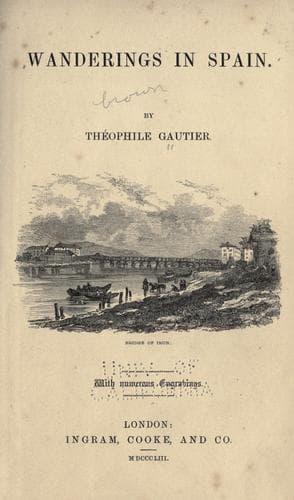
Gautier, Théophile, 1811-1872 -- Travel -- Spain; Spain -- Description and travel; Spain -- Social life and customs -- 19th century
At the turn of a bridge, admirably adapted for an ambuscade of
brigands, we beheld a small column surmounted by a cross. It was
erected to the memory of a poor devil who had ended his days in
this narrow pass, in consequence of his having fallen a victim to
_manoairada_ (violent death). From time to time we met travelling
_maragatos_, in their costume of the sixteenth century, which
consists of a tight-fitting leathern doublet, fastened with a
buckle, wide breeches, and a broad-brimmed hat. We also met several
_Valencianos_, with their white linen drawers, like the robes of
the Klephts, their handkerchief twisted about their head, their
white gaiters bordered with blue, and without feet, after the
fashion of the antique _Knemis_, and their long piece of cloth
(_capa de muestra_), crossed diagonally by bright-coloured stripes,
and draped over their shoulders in a very elegant manner. All
that we could perceive of their flesh was as tawny as Florentine
bronze. Then, again, we saw strings of mules, caparisoned in the
most charming fashion, with bells and party-coloured fringe and
housings, while their _arrieros_ were armed with carbines. We were
enchanted, for we had found an abundant supply of the picturesque
of which we were in search.
The higher we ascended, the thicker and broader became the strips
of snow; but a single sunbeam made the mountains stream with water,
like a woman laughing in the midst of her tears; on every side
little brooks, scattered about like the dishevelled tresses of some
Naïad, and clearer than crystal, forced their way downwards. By
dint of climbing, we reached the summit of the range, and seated
ourselves on the plinth of a large granite lion, which is situated
on the further side of the mountain, and marks the boundary of Old
Castile; beyond this lion the province of New Castile commences.
We took a fancy to cull a delicious red flower, whose botanical
name I do not know, and which was growing in the fissures of the
mountain. This necessitated our clambering up on a rock, which
is said to be the place where Philip II. used to sit to see how
the works of the Escurial were advancing. Either the tradition is
apocryphal, or Philip II. must have possessed most astoundingly
good eyes.
The coach, which had been toiling up the precipitous steeps, at
last rejoined us once more. The oxen were unyoked, and we descended
the declivity in a gallop. We stopped to dine at Guadarrama, a
little village crouched at the foot of the mountain. The only
ornament of which it can boast is a granite fountain, erected by
Philip II. At this place, by a strange reversion of the natural
order of dinners, goats' milk soup was served up as dessert.
Public-domain text, read in full here on John Shaqi.
Reviews
Reviews
No reviews yet
Be the first to share your thoughts on this work.
Elsewhere in the archive
Join the Discussion
Join the discussion
Sign in to leave a comment or review.
Sign InorCreate an account