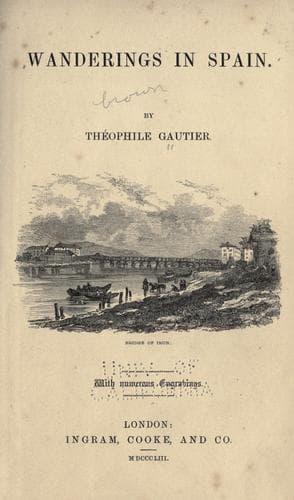
Gautier, Théophile, 1811-1872 -- Travel -- Spain; Spain -- Description and travel; Spain -- Social life and customs -- 19th century
Madrid, like Rome, is surrounded by a desert; it is impossible
to convey an idea of its aridity and desolation. There is not a
tree, a drop of water, a green plant, or the least appearance
of humidity; nothing but yellow sand and iron-grey rocks; and
when you leave the mountain, you do not find even rocks, but
large stones. From time to time you perceive a dusty _venta_, a
cork-coloured spire, just showing its nose on the horizon, large
melancholy-looking oxen dragging along one of the cars we have
already described; a countryman on horseback, or on a mule, with
a fierce expression of face, a carbine at his saddle-bow, and a
sombrero slouched over his eyes, or long strings of whity-brown
asses, carrying chopped straw, which is corded up with a network
of small ropes, and that is all. The ass which walks first, the
_coronel_, has always a small feather or rosette, indicating his
superiority in the hierarchy of the long-eared tribe.
At the expiration of a few hours, which our impatience to reach our
destination caused to appear still longer than they really were, we
at last perceived Madrid with tolerable distinctness. A few minutes
afterwards we entered the Spanish capital by the _Puerta de
Hierro_, and drove along an avenue planted with dwarf pollards and
bordered by small brick towers which serve to raise water. Talking
of water, although the transition is not very well timed, I forgot
to mention that we crossed the Manzanares by means of a bridge that
was worthy of a river of a more serious description; we then passed
by the Queen's Palace, one of those edifices which people are
pleased to designate as tasty. The immense terraces on which it is
raised give it rather a grand appearance.
After having undergone the visit of the custom-house officials, we
proceeded to take up our quarters in the immediate vicinity of the
_Calle d'Alcala_ and of the _Prado_; the name of our street was the
_Calle del Caballero de Gracia_, and our hotel was called _La Fonda
de la Amistad_, where Madame Espartero, Duchess de la Vittoria,
happened at that time to be staying. The first thing we did was to
despatch Manuel, our temporary servant, a most ardent _aficionado_
and tauromachist, to procure us tickets for the next bull-fight.
CHAPTER VI.
MADRID.
Bull-fights--The Arena--Calesins--Espadas, Chulos, Banderilleros,
and Picadores Sevilla the Picador--La Estocada a Vuela Pies.
We were obliged to wait two days. Never did two days appear so long
to me, and in order to overcome my impatience, I read over more
than ten times the bills posted up at the corners of the principal
streets. These bills promised wonders; they announced eight bulls
from the most famous pasturages; the _picadores_, Sevilla and
Antonio Rodriguez; and the _espadas_, Juan Pastor, also called _El
Barbero_, and Guillen; they wound up by prohibiting the public from
throwing into the arena orange-peel or any other projectile capable
of injuring the combatants.
Public-domain text, read in full here on John Shaqi.
Reviews
Reviews
No reviews yet
Be the first to share your thoughts on this work.
Elsewhere in the archive
Join the Discussion
Join the discussion
Sign in to leave a comment or review.
Sign InorCreate an account