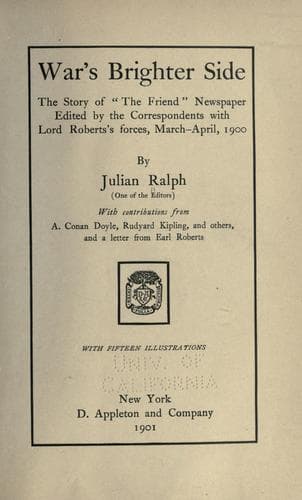
War's Brighter Side: The Story of The Friend Newspaper Edited by the Correspondents with Lord Roberts's Forces, March-April, 1900Ralph, Julian
History
War's Brighter Side: The Story of The Friend Newspaper Edited by the Correspondents with Lord Roberts's Forces, March-April, 1900
Ralph, Julian
Friend (Bloemfontein, South Africa); South African War, 1899-1902 -- Periodicals
And now I am going to tread on delicate ground. We have all our little
idiosyncrasies, and gunners are not without theirs. They will have
nothing to say to the Vickers-Maxim. "It is a toy and not a gun," I
have heard many a gunner declare. But I contend that we have never
used it properly. Lord Dundonald's galloping Maxim was intended to
accompany cavalry. Why not have a galloping "pom-pom"? It can be
brought into action with great speed, it has a great range, and
everybody will agree that it is a most accurate gun. It would have
been most useful against the Boers when they fled from Poplar Grove,
and its effect upon a battery coming into action is not to be
despised, as the gallant T Battery will testify from their experiences
at Driefontein. Again, its use on kopjes held by cavalry pending the
arrival of infantry would surely be beneficial. It has a demoralising
effect; even more so than a percussion shrapnel, and our enemy in the
present campaign is particularly susceptible to demoralisation when
operating in open ground.
One of the difficulties with which the artillery in the present
campaign has had to contend has been to find out the extent of our
infantry advance for which they are preparing with a bombardment. As
the Mauser and Lee-Metford render early cover necessary for infantry,
it has come about that our infantry, while seeking to render itself
invisible to the enemy, has succeeded in making itself almost entirely
invisible to our supporting artillery. On many occasions our artillery
has ceased fire long before it was necessary, because it became
impossible to tell how far our advance extended, for no artillery
officer--and rightly so--will run the risk of inflicting damage on his
own infantry. The remedy for this state of things has yet to be
discovered.
In making public opinions such as these--the opinions of a mere
layman--I should feel inclined to make some kind of apology, knowing
as I do that they are liable to be read by men whose whole life is
devoted to the practice as well as the theory of the use of artillery
in the field, were it not for the fact that I am optimistic enough to
believe that my remarks will provoke criticism. I am aware that the
British officer is not much given to rushing into print, but I am also
convinced that he will not sit tamely by when heresies are propagated.
If, therefore, the views I have enounced are unsound and unpractical,
it is his bounden duty to contradict them. And in doing so he will
probably contribute his own views, which will undoubtedly receive far
greater attention, from the fact that they are set forth by men
actually serving in the field, than if they are kept back till the end
of the war, when a successful issue will probably bring with it apathy
on the part of those in whose hands rest the destinies of the British
Army.
* * * * *
THE NEW MACHINE GUN.
Public-domain text, read in full here on John Shaqi.
Reviews
Reviews
No reviews yet
Be the first to share your thoughts on this work.
Elsewhere in the archive
Join the Discussion
Join the discussion
Sign in to leave a comment or review.
Sign InorCreate an account