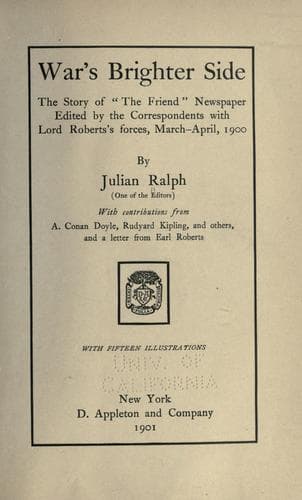
War's Brighter Side: The Story of The Friend Newspaper Edited by the Correspondents with Lord Roberts's Forces, March-April, 1900Ralph, Julian
History
War's Brighter Side: The Story of The Friend Newspaper Edited by the Correspondents with Lord Roberts's Forces, March-April, 1900
Ralph, Julian
Friend (Bloemfontein, South Africa); South African War, 1899-1902 -- Periodicals
_Four Correspondents Dine the General, the Governor, and
Rudyard Kipling, and Produce_ THE FRIEND _as well_.
"Alles zal recht komen" were the words of the late President Brand,
true friend of the English, which were graven on the pedestal of his
statue before the doors of the Residency. We repeated them in new
"tabs" beside the heading of our paper on March 28th, with an amended
English translation facing them: "All has come right."
"All shall come right," we said, in our editorial, "was the motto of
the late Orange Free State. What a prophet was he who conceived it,
and how quickly has come the fruition of his prophecy! All has come
right."
We published an appreciative editorial upon Sir Alfred Milner, who had
come on the previous day upon a visit to Lord Roberts. It was written
by Mr. Landon. Mr. Kipling contributed more "Kopje-Book Maxims," and
bore a heavy hand in the production of an amusing column, entitled,
"The Military Letter Writer."
This was the way that column came into being. Mr. Landon, Mr. Kipling,
and I were in the poet's bedroom when Mr. Landon produced a model
letter-writer which he had found somewhere. I take great credit for
the phrase "found somewhere"; it might, with any other man than Mr.
Landon, be so full and rich in meaning. The book professed to be a
sober guide to the young and the ignorant in the paths of epistolary
literature; therefore it was bound to be supremely funny. We screamed
over what Landon read to us out of it.
Said Mr. Kipling: "Let's write some model military letters," and, as
was his wont, he seized a pencil and paper and began to write No. 1,
reading as he wrote. He urged us both to contribute, and Mr. Landon
tried with much good intent, while I wished to do so, but could not
begin to keep pace with the poet. Instant collaboration is almost
always impossible, especially where the inspiration comes to one man
who is seized by it, and begins to give it expression before his
companions can match their minds with his. Therefore Mr. Kipling went
on and on, and Mr. Landon took the block and pencil and wrote as Mr.
Kipling talked. Thus were produced letter No. 1 and the italicised
introduction to No. 2; the rest Mr. Landon arranged and edited out of
his book.
The column was pieced out at the end with No. 3 of Mr. Kipling's
"Fables for the Staff," which was, therefore, hidden in a bottom
corner of the page--a stroke of genius on the part of those whom we
anathematised collectively in the singular number as "The Dutch
Compositor."
Public-domain text, read in full here on John Shaqi.
Reviews
Reviews
No reviews yet
Be the first to share your thoughts on this work.
Elsewhere in the archive
Join the Discussion
Join the discussion
Sign in to leave a comment or review.
Sign InorCreate an account