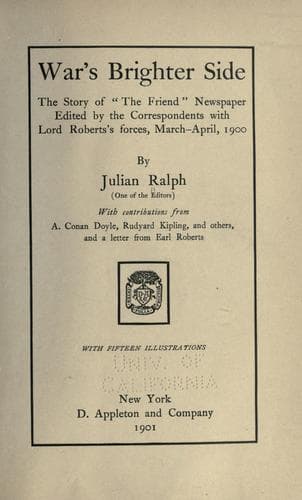
War's Brighter Side: The Story of The Friend Newspaper Edited by the Correspondents with Lord Roberts's Forces, March-April, 1900Ralph, Julian
History
War's Brighter Side: The Story of The Friend Newspaper Edited by the Correspondents with Lord Roberts's Forces, March-April, 1900
Ralph, Julian
Friend (Bloemfontein, South Africa); South African War, 1899-1902 -- Periodicals
I see my handsome and gifted colleague, Mr. Landon, rise to toast the
High Commissioner. What's this we hear? He is welcoming the Viceroy as a
brother in journalism, a newspaper man like ourselves. Up rises the man
who lives in the heart of care and the furnace of dissension--pale,
grave, concentrated, like one who thinks of but one thing and has but
one thing to do--and that a thing gigantic. He replies that it is true
that he was once a writer like ourselves; that he enjoyed those days;
that he made delightful friends and spent glad hours in them; that he
has had much to do with the gentlemen of the Press in Capetown, and that
his relations with all have been without a flaw. After that he speaks
but little of the heart of care where his official bed is laid, or of
the furnace blasts of treason and of discord round his chair at the
Cape, but, with unassumed modesty, calls our attention to the military
magician across the table and to what he has done.
It is Mr. Gwynne who rises next--one of the very best-equipped war
correspondents with the British forces, both as a campaigner and a
critic of war, and high among the best as a writer. It is fitting that
he should introduce the Field-Marshal, for he is liked and trusted by
his distinguished guest, who has discovered, I fancy, that under the
correspondent's khaki beats the heart of the soldier.
Lord Roberts replied that he was very proud to be the guest of the war
correspondents. He liked to have them with him, and he was glad when
they criticised whatever was amiss, for he profited by reading what
they said. Turning to us, the Field-Marshal remarked, "You share all
our hardships and exposure. All the troops do not engage in every
battle, but you go to all, so that you experience even more danger
than most of us. May I call you 'comrades'?"
I remember that he spoke earnestly of the work Sir Alfred Milner was
doing, and credited that statesman with the most difficult task of any
man who served the Empire. One other bit of his address I recall--a
mere phrase, but a remarkable one: "The gentlemen I command--my
gentlemanly army."
It was my good fortune to introduce Rudyard Kipling--a delicate as
well as a proud task, because I knew that fulsome praise, or even the
most honest appreciation, would make him uncomfortable. I remember
that I spoke of the narrow compass of Shakspere's renown in his day,
and the world-wide fame of a man like Kipling in these days of
multitudinous newspapers and telegraphs and cables.
Public-domain text, read in full here on John Shaqi.
Reviews
Reviews
No reviews yet
Be the first to share your thoughts on this work.
Elsewhere in the archive
Join the Discussion
Join the discussion
Sign in to leave a comment or review.
Sign InorCreate an account