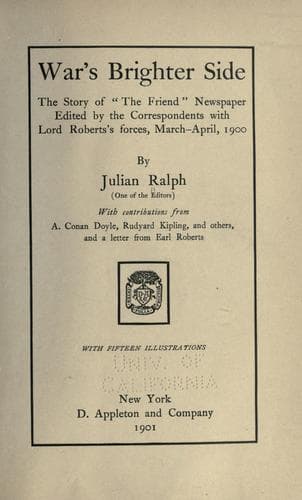
War's Brighter Side: The Story of The Friend Newspaper Edited by the Correspondents with Lord Roberts's Forces, March-April, 1900Ralph, Julian
History
War's Brighter Side: The Story of The Friend Newspaper Edited by the Correspondents with Lord Roberts's Forces, March-April, 1900
Ralph, Julian
Friend (Bloemfontein, South Africa); South African War, 1899-1902 -- Periodicals
In this number of the paper Mr. Barnes published No. 4 of Mr.
Kipling's "Fables for the Staff," and the poem by Mr. Kipling on
Perceval Landon's birthday. "A Realistic Comedy," by an anonymous
writer, the third of Mr. Gwynne's articles on the art of war, and a
bit of a brief correspondence between the army telegraphists and Mr.
Bennet Burleigh were also in this entertaining number.
Mr. Barnes was exceedingly well liked by all who knew him in the army,
and was much sought as a companion, for his unvarying good humour and
for such a fund of anecdotes, songs, and imitations as was possessed
by no one else of our acquaintance. I think the best of his anecdotes
of his own experiences in the war was concerning the Boer losses at
Driefontein. The British had found more than sixty bodies, and knew
that fifty other Boers had been killed. (I will not say that these are
the exact figures, but they give a just idea of the actual losses of
the Boers.) Nevertheless, when Barnes questioned a Boer prisoner taken
at that battle, the man said that his force had suffered a loss of
only eight killed.
"Then who is it that gets killed by our bullets in all these fights?"
Barnes asked. "We fight you, and after each battle we see the dead
being carried off; we find other dead on the field, and we see the
loose mounds of earth under which you have hastily buried others. Who
are these dead men?"
"I don't know," said the prisoner, "our commandant said we only had
eight men killed at Abraham's Kraal (Driefontein)."
"I understand," said Barnes. "He must know how many you lost. But we
saw over sixty dead bodies where you had been fighting. Whose bodies
do you suppose they were? Not Boers, of course, but still, they
belonged to some people who had been shot. There seems to be in South
Africa a mysterious race of people who follow you around in this war
and persist in getting in the way of our bullets. I should think you
would warn them of their danger, or give orders for them to stop
coming to all the battles. They may have wives and children who mourn
them; at all events, they are not needed as filters in all the rivers,
or for starting informal cemeteries all over the veldt as they have
been doing ever since the fighting began. I wonder what people they
are."
"I don't know. We only lost eight," said the Boer.
"And we buried sixty," said Barnes. "Really you ought to find out who
these bullet-stoppers are, and warn them not to be always getting
killed by us who have no quarrel with them and are only trying to
shoot Boers."
Another of Mr. Barnes's tales is of that awful daybreak massacre at
Maghersfontein. Mr. Barnes was forging ahead to learn what had
happened when he met three men in kilts dashing over the veldt, away
from the battle.
"Here," Mr. Barnes cried, "who are you? Where are you going?"
"Oh, mon," said one of the poor unnerved chaps, "we are a' that's left
o' the ---- ----."
Public-domain text, read in full here on John Shaqi.
Reviews
Reviews
No reviews yet
Be the first to share your thoughts on this work.
Elsewhere in the archive
Join the Discussion
Join the discussion
Sign in to leave a comment or review.
Sign InorCreate an account