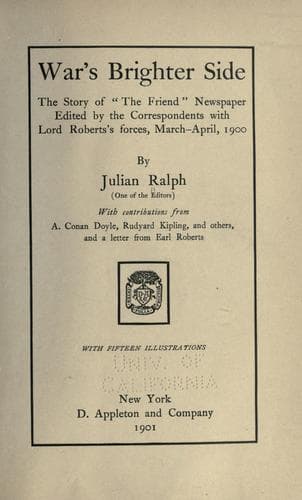
War's Brighter Side: The Story of The Friend Newspaper Edited by the Correspondents with Lord Roberts's Forces, March-April, 1900Ralph, Julian
History
War's Brighter Side: The Story of The Friend Newspaper Edited by the Correspondents with Lord Roberts's Forces, March-April, 1900
Ralph, Julian
Friend (Bloemfontein, South Africa); South African War, 1899-1902 -- Periodicals
Then, Mr. Rudyard Kipling, here's more work for you to do,
You've sung of gallant "Tommies" and their deeds,
Just write about their N.C.O.'s and give them all their due,
For good N.C.O.'s are what the Army needs.
C.
* * * * *
IS THE ART OF WAR REVOLUTIONISED?
BY. H. A. GWYNNE.
III.--_Cavalry._
The "Art of War," which, I must confess, is but a feeble equivalent
for the _art militaire_ of the French, covers strategy and tactics. In
discussing the duties of any particular arm in warfare it is obvious
that the discussion must necessarily deal with tactics rather than
strategy, which, I take it, will not undergo any great change as long
as human nature remains subject to its present limitations. But the
arm which I am now discussing has been and will be in the future even
more the chief instrument used by a general who wishes to carry out
big strategic movements. Wherefore cavalry must, above all things, be
mobile, ready to move at the shortest moment, prepared in every
respect to carry out quickly the ideas of the commander.
The "strategic arm," as the cavalry has been styled, has been called
upon, during the present campaign, to face difficulties which have
been almost unknown in former campaigns. First and foremost it has had
to operate against an army of mounted infantry, more mobile than
itself. Waterless plains, heat, and short rations, have been
difficulties which in Europe would be absent. Foreign criticisms on
the operations of our cavalry in the present campaign are based on
false premises, inasmuch that their authors assume a plentiful supply
of water, an equable climate, an easy transport, and a fair amount of
supplies. They have not taken into account the fact that our cavalry
have had to cut themselves off from all supplies in what, for all
practical purposes, is a howling desert, for the English horses have
steadily refused to touch the veldt-grass. If there is one criticism
on the operations of our cavalry which can in any sense be justified,
it is that in many cases we have made it an objective of our movements
to charge the enemy. By doing so, we have perhaps sacrificed
opportunities of outflanking the Boers for the illusive chance of
proving the efficiency of the _arme blanche_ on an enemy, whose only
weapon is a rifle. I once heard a distinguished cavalry officer
declare that it was his conviction that in a two-mile race, starting
fair, the Boer, mounted on his little African pony, would outpace our
troopers riding a big English horse and carrying an equipment which
reminded him of the picture of Father Christmas. But as over two
million people have at different times criticised the weight of
cavalry equipment, and nobody, except the Boer, has given us a remedy,
we may leave this portion of our subject to lecturer--the U.S.
Institute.
Public-domain text, read in full here on John Shaqi.
Reviews
Reviews
No reviews yet
Be the first to share your thoughts on this work.
Elsewhere in the archive
Join the Discussion
Join the discussion
Sign in to leave a comment or review.
Sign InorCreate an account