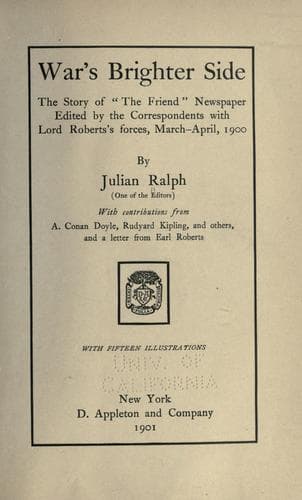
War's Brighter Side: The Story of The Friend Newspaper Edited by the Correspondents with Lord Roberts's Forces, March-April, 1900Ralph, Julian
History
War's Brighter Side: The Story of The Friend Newspaper Edited by the Correspondents with Lord Roberts's Forces, March-April, 1900
Ralph, Julian
Friend (Bloemfontein, South Africa); South African War, 1899-1902 -- Periodicals
W. A. Koller, the town clerk, notified all residents to call upon him
and make a true statement of the _bona fides_ of all their possessions
in horseflesh. Captain P. Holland-Pryor, A.A.G., requested every
burgher who had not given up any Government horse in his possession to
do so without delay. Truly, the horse occupied a large share of
interest and attention--much larger now that we were in need of horses
than when they had come in abundance from every corner of the earth.
We published a remarkable address to the Free Staters by the Rev. A.
A. Van der Lingen, once a candidate for the Presidency. He asked them
if it was right for them to assail the peaceful territories of the
British when thousands of their kith and kin are enjoying a full and
perfect measure of equality and justice. He demanded to know "what you
think seriously, in your own minds, will become of you if you
prosecute the war and lose." The "old soldiers of Bloemfontein"--it
seems there were eight retired veterans--cheered the Field-Marshal
with an address.
[Illustration: _Julian Ralph and his horse "Rattlesnake._"]
Our five-guinea competition for the renaming of the Colony went on
apace, and we recorded a great day of sport among the men of the Sixth
Division, who enjoyed the band of the Buffs and the pipes of the
Seaforths, Gordons, Black Watch, and Argyle and Sutherland
Highlanders. Major the Honourable Robert White directed the sports
with greater success than had attended anything of the kind among our
troops on this side of Natal.
The soldiers still filed into our bare and dirty quarters asking for
the paper, and one of them complained that it was not sent out to his
camp, and that he had to come in and get it.
"Canadian, aren't you?" Mr. Kipling asked, "from out on the wheat
belt?"
"Yes, sir."
"Why, man, then what are you talking about? You'd ride in to Winnipeg,
twenty miles, to get a paper if you were at home."
Mr. Kipling on this day wrote a tribute to General Joubert, whose
death had just been made known to us. Hours after he wrote the poem,
when tired of waiting to see the proof, he walked over to the
printing-office, broke in by way of a window, and set up the last line
of it at one of the printers' cases. What the printers thought of him
we never knew, but he never forgot that the first bit of paper he
picked up from the floor of the editorial room, when he was looking
for something that had fallen from the table, was a violent attack
upon himself in a piece of a Free State newspaper.
The only bit of all our work that our compositors saved was this poem
to Joubert. That and a portrait of the late firebrand, Borckenhagen,
were the only ornaments they deemed worthy to decorate their
composing-room walls.
There were at least two English-speaking men among them. I grant to
them the benefit of the doubt whether my reflections should extend to
them also.
* * * * *
THE FRIEND.
Public-domain text, read in full here on John Shaqi.
Reviews
Reviews
No reviews yet
Be the first to share your thoughts on this work.
Elsewhere in the archive
Join the Discussion
Join the discussion
Sign in to leave a comment or review.
Sign InorCreate an account