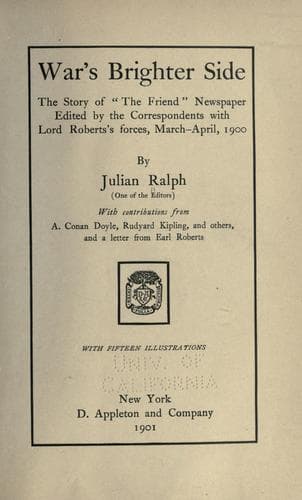
War's Brighter Side: The Story of The Friend Newspaper Edited by the Correspondents with Lord Roberts's Forces, March-April, 1900Ralph, Julian
History
War's Brighter Side: The Story of The Friend Newspaper Edited by the Correspondents with Lord Roberts's Forces, March-April, 1900
Ralph, Julian
Friend (Bloemfontein, South Africa); South African War, 1899-1902 -- Periodicals
Mr. Ralph,
Mr. Scull, of Chicago,
Mr. Buxton, of _The Friend_
are the 3 men behind the Censor.
Mr. Pearse, _Morning Post_.
Mr. Bennett Burleigh, _Daily Telegraph_.
W. B. Wollen, R.I.
Mr. Maxwell, of the _Standard_.
Mr. Melton Prior.
Mr. Rennet, of "Laffan's Bureau."
_Lord Stanley Censoring Reports of a Battle. Photographed by Mr. H.
Mackern, of "Scribner's Magazine."_]
Perhaps the reader will see at this date and stage of the discussion
over the lessons of the war that the practical, and with him wholly
original, words spoken by Lord Dundonald in London on December 15th,
were in some measure anticipated by Lord Stanley in this editorial.
Both these noblemen set the same high value upon the services of the
men of England without regard to class. Lord Dundonald said they would
fight when called upon, but the best of them would not willingly or
comfortably undergo the exactions of long-sustained military
discipline. Our Censor was, at that time, for making their service an
instantly ready organised source of strength to the Empire.
Though there is little to republish from the columns of THE FRIEND of
that day, the newspaper was a very complete and excellent collation of
news of South Africa, the war, and the world. On this particular day,
April 3rd, we published one of Mr. G. W. Steevens's artistic letters
from the Natal front, taken from the _Daily Mail_; we copied an
important article on the lessons of the war written by Mr. Amery for
the _Times_, and altogether the army found the number very readable.
* * * * *
THE FRIEND.
(_Edited by the War Correspondents with Lord Roberts' Force._)
No. 15.] BLOEMFONTEIN, TUESDAY, APRIL 3, 1900. [Price One Penny.
A LESSON LEARNED.
BY LORD STANLEY.
This war, with the opportunity it has offered to all branches of the
service to see how the military machinery works when running at high
pressure, must teach not only those who are out here superintending
and running the machine, but also those at home who are paying for its
running, many a useful lesson.
That the machine has worked smoothly nobody for one minute will
assert--but it certainly has run sufficiently smoothly to show that,
with some alteration which experience alone could suggest to be
desirable, our military engine may very easily be made as perfect as
those of the Continental Powers are popularly supposed to be.
But it is not our intention to show what failings have been
discovered, and what lessons in manoeuvring--in transport--in
equipment--are required to be learned. Our object to-day is to
congratulate ourselves that one lesson at least which had to be
learned has been partially learned--and that is that England must look
not to one class or two classes of men for her soldiers and sailors,
but must be able to draw upon all sorts and conditions of men, the
rich alike with the poor, when she has to defend her honour at home or
abroad.
Public-domain text, read in full here on John Shaqi.
Reviews
Reviews
No reviews yet
Be the first to share your thoughts on this work.
Elsewhere in the archive
Join the Discussion
Join the discussion
Sign in to leave a comment or review.
Sign InorCreate an account