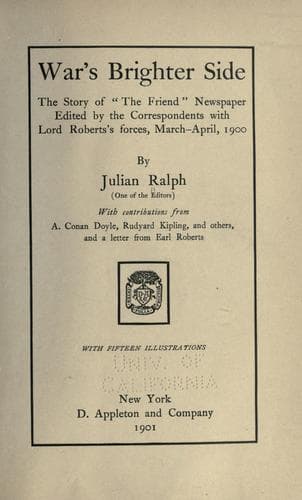
War's Brighter Side: The Story of The Friend Newspaper Edited by the Correspondents with Lord Roberts's Forces, March-April, 1900Ralph, Julian
History
War's Brighter Side: The Story of The Friend Newspaper Edited by the Correspondents with Lord Roberts's Forces, March-April, 1900
Ralph, Julian
Friend (Bloemfontein, South Africa); South African War, 1899-1902 -- Periodicals
They turned us out of the field hospital one night at 9, and we were
jolted along in buck-waggons till 5 the next morning, then a halt of 5
hours, and at last we got to Norval's Pont at 5 p.m., after the worst
journey I ever hope to have. It was quite a treat seeing trees again,
as some of the country we passed through was really pretty. Our
ambulance train consisted of layers of stretchers, one above the
other, on a large "bogey" truck. At Springfontein, we were entrusted
to a German ambulance, from Hamburg, covered with crosses, doctors,
nurses and patient helps, but they were very kind to us.
We got news daily from the station telegraphist, Mr. Fryer, and Mr.
Shipp, also employed on the station, till the escape from Pretoria put
an end to our visitors. The hospital was half full of Boers, and they
seemed perfectly happy sitting still the whole day long doing nothing,
but smoking hard. Two engines were always left ready for emergency,
the line being 100 yards away, so sleep at night was a matter of
difficulty. Just when I was hoping we should be relieved, they moved
us under the safe keeping of a Bloemfontein policeman in a gorgeous
blue uniform to the Volks Hospital here, passing through hundreds of
sleeping burghers in the station. Here we languished in the utmost
comfort, till the famous Tuesday when little black specks on the veldt
and the arrival here of "Bobs" made our scarce-believing eyes quite
certain that we were no longer Boer prisoners.
ANON.
* * * * *
ENTERIC FEVER.
BY AN ARMY SURGEON.
No disease causes such havoc in modern campaigns as typhoid or enteric
fever, and it becomes the duty of every one having authority to
impress this fact upon the men committed to their charge. More
especially is this duty imperative when troops are on the march, for
many a valuable life is thrown away by the want of the strong hand of
a wise discipline. When thirsty, men will drink anything, and it is
here that good may be done. It is reported that one regiment on the
march recently made the use of water-bottles a matter of drill, the
word of command being given every hour for a mouthful of water to be
drunk. As a result, men arrived in many cases at their bivouac with
some water still left from their morning supply, without being one
whit more thirsty than their neighbours.
Public-domain text, read in full here on John Shaqi.
Reviews
Reviews
No reviews yet
Be the first to share your thoughts on this work.
Elsewhere in the archive
Join the Discussion
Join the discussion
Sign in to leave a comment or review.
Sign InorCreate an account