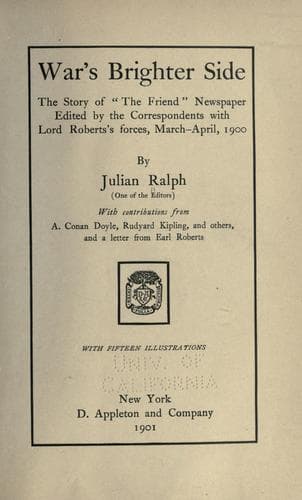
War's Brighter Side: The Story of The Friend Newspaper Edited by the Correspondents with Lord Roberts's Forces, March-April, 1900Ralph, Julian
History
War's Brighter Side: The Story of The Friend Newspaper Edited by the Correspondents with Lord Roberts's Forces, March-April, 1900
Ralph, Julian
Friend (Bloemfontein, South Africa); South African War, 1899-1902 -- Periodicals
The air began to fill with rumours of murder and pillage, the veldt
again resounded with the hoof-beats of fighting commandos. We had the
affairs at Reddersburg, Wepener, Karree Siding, Sanna's Post. We found
that we were brushing our coatsleeves against those of active enemies
in Bloemfontein--men who were apprising the enemy of our army
movements and plans, who were even said to be slipping out at night,
armed sometimes with messages and sometimes with Mausers.
Thus the Boer cunning over-reached itself. It was the biggest hoax,
the climax of the long course of hoaxing. It was the first time it had
been practised upon Lord Roberts, but I also believe it was the last
time as well.
This was the meaning of the notices that now began to appear in
different forms in THE FRIEND: that the Army was to be fooled no
longer by mere lies and Iscariot handshakings. This was the purport of
Lieutenant Burnett-Hitchcock's command that we should all carry
passes; of Town Clerk Koller's order for all the Free Staters to give
an account of their horses with proofs of ownership; of General
Kelly's command that all troops "when out in positions" (around the
town and elsewhere) "should invariably entrench themselves ... being
careful that their flanks are secure"; of Lord Roberts's warning that
our "friends" and others were to be held responsible in their persons
and property for all wanton destruction of or damage to public or
private property, which meant railway-wrecking principally.
The Army at last was tired of being fooled.
The editorial of the day was conceived in the same spirit of
resistance to a farther continuance of the experiences of the Army in
the past. It was headed "British Leniency," and was, I am almost
certain, written by Mr. Gwynne under "inspiration."
Public-domain text, read in full here on John Shaqi.
Reviews
Reviews
No reviews yet
Be the first to share your thoughts on this work.
Elsewhere in the archive
Join the Discussion
Join the discussion
Sign in to leave a comment or review.
Sign InorCreate an account