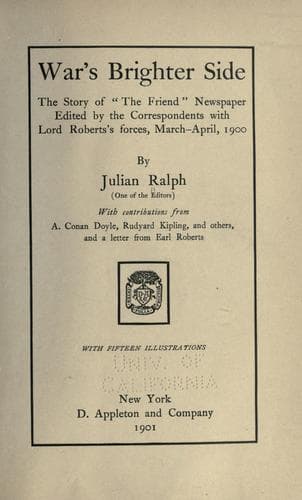
War's Brighter Side: The Story of The Friend Newspaper Edited by the Correspondents with Lord Roberts's Forces, March-April, 1900Ralph, Julian
History
War's Brighter Side: The Story of The Friend Newspaper Edited by the Correspondents with Lord Roberts's Forces, March-April, 1900
Ralph, Julian
Friend (Bloemfontein, South Africa); South African War, 1899-1902 -- Periodicals
Death was thick in the air. Nearly every correspondent and officer
counted more friends who were sick than he had known to be wounded or
killed in battle. The rains had set in. The veldt was like a marsh.
The nights were bitterly cold. The dead in their blankets pursued us
in the streets of the town and on every ride we took upon the veldt.
My concern for my son took me daily to the Volks Hospital, where the
doctor and nurses said that enteric in Bloemfontein took on so mild a
form that they should "consider it a lasting disgrace to have a
patient die of that disease," and yet every time I went to that
hospital I heard from other visitors how many were the deaths in the
army hospitals. I heard, too, how bad were the sanitary arrangements,
how inefficient were the often untrained "Tommy" nurses, how dreadful
were the risks the patients were obliged to take (in some field
hospitals) in obeying the commands of nature.
Now that I have returned to England I have had a high official of the
Medical Corps say to me, "It was known beforehand that the service
must break down in war because it was undermanned; it was never made
familiar with its work, it had too few reserves to draw upon; when it
was distended by the sudden and extraordinary demands of war it had to
grow on paper, but not in fit and proper _personnel_ or _materiel_."
Here, then, is the basis for what must, sooner or later, be exposed to
all the nation. Knowing that things were amiss, and that they could
not have been otherwise, the people need not wait two or five years
for all the facts, or for the creation of a mis-applied "sensation."
Let them doggedly and firmly insist that the loudly promised reform of
the army shall be certain to include the establishment of a properly
trained, equipped, and proportioned R.A.M.C., and that the lingering
prejudice of the regular army officer against this most useful,
economic, and essential corps shall vanish before the will of the
people as stubble is swept up by a prairie fire.
Mr. Gwynne wrote the obituary notice of Archibald Forbes, Mr. Fred W.
Unger wrote a descriptive article called "The Inexpressible Veldt,"
and we were rejoiced once again to publish a contribution in verse by
Mr. A. B. Paterson, of Sydney.
* * * * *
THE FRIEND.
(_Edited by the War Correspondents with Lord Roberts' Force._)
No. 18. BLOEMFONTEIN, FRIDAY, APRIL 6, 1900 [Price One Penny.
TAKEN FROM THE OFFICE OF "THE FRIEND."
Monday or Tuesday, a pair of Field Glasses, a pair of Wire Cutters,
and Leather Pouch. Please return same and claim reward.[16]
[Footnote 16: The victim of this bold theft out of our sanctum was Mr.
James Barnes, our occasional contributor and assistant.]
* * * * *
NOTICE.
The time by which Civilians have to be in their houses is extended to
9 p.m. on Sundays, to enable them to return from Church.
Public-domain text, read in full here on John Shaqi.
Reviews
Reviews
No reviews yet
Be the first to share your thoughts on this work.
Elsewhere in the archive
Join the Discussion
Join the discussion
Sign in to leave a comment or review.
Sign InorCreate an account