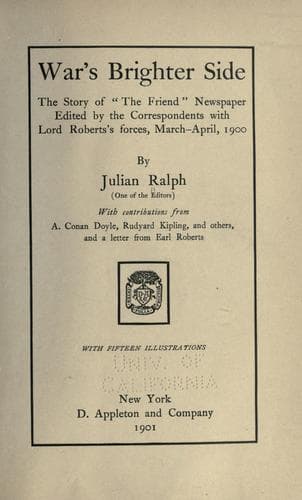
War's Brighter Side: The Story of The Friend Newspaper Edited by the Correspondents with Lord Roberts's Forces, March-April, 1900Ralph, Julian
History
War's Brighter Side: The Story of The Friend Newspaper Edited by the Correspondents with Lord Roberts's Forces, March-April, 1900
Ralph, Julian
Friend (Bloemfontein, South Africa); South African War, 1899-1902 -- Periodicals
The largest advertisement in the paper was that of Murray Guthrie,
Esq., M.P., whose address just then was "the Railway Station." He was
most generously giving up his time to the receipt and distribution of
those parcels for the troops which were now beginning to come from
England in great and little packing-cases, and large and small bundles
numbering enough to be reckoned by the car-load.
[Illustration: _The Capitulation of Bloemfontein._
_From a painting by Lester Ralph._]
We had received the news of the killing of Colonel de
Villebois-Mareuil in an engagement with Lord Methuen's force, and
Mr. Gwynne wrote a spirited leader in honour of the Frenchman's
memory.
We heard some interesting details about the capture of Villebois,
which I think have never been published. His commando threatened
Boshof, and when our force began to attack the kopje where he was
lodged our second shell killed him. He was not the only nobleman in
his commando, for among the prisoners we captured one was a Russian
prince and another was the Comte Breda, a Frenchman, like his leader.
Another prisoner was a stalwart Englishman named Simpson, whose long
beard was braided to keep it out of the way when he was shooting.
Physically, he was the most splendid specimen of manhood our soldiers
had seen in the Boer ranks. Lord Methuen ordered a military burial,
and commanded Colonel Higgins of the Third Welsh Borderers to obtain a
fitting tombstone. The English general attended the funeral, which
took place in Boshof cemetery. "General" Villebois was buried in a
blanket, but this was covered by the Union Jack when the body was
solemnly borne to the grave between the lines of the men of the Loyal
North Lancashire Regiment. No chaplain officiated, but none of the
formalities of a complete military service were omitted. The Comte
Breda made a little speech at the close, thanking the British for
their courtesy and kindness. After that our own dead were buried in
the same little cemetery.
The affair provoked great and deep discussion, and so many British
officers were displeased by what Lord Methuen had seen fit to do that
THE FRIEND was at pains to try and clear the air of the false
impression that one brave general had not a right to honour another
in this soldierly way. We also pictured Villebois as he appeared to
us, a knight of ancient pattern, a restless, gallant warrior, who had
political reasons for wishing to keep himself in the mind of his
people while waiting for the ripening of his plans. The line on his
gravestone, "died on the field of Honour," was originally written "on
the field of battle," and was ordered to be changed at the last
moment. This phrase also angered many British, who, presumably,
thought that a grand monument had been set up over the unfortunate
Frenchman. In fact, the stone only cost ten pounds when dressed and
inscribed, and in a country where such things fetch twice their value
here.
* * * * *
THE FRIEND.
Public-domain text, read in full here on John Shaqi.
Reviews
Reviews
No reviews yet
Be the first to share your thoughts on this work.
Elsewhere in the archive
Join the Discussion
Join the discussion
Sign in to leave a comment or review.
Sign InorCreate an account