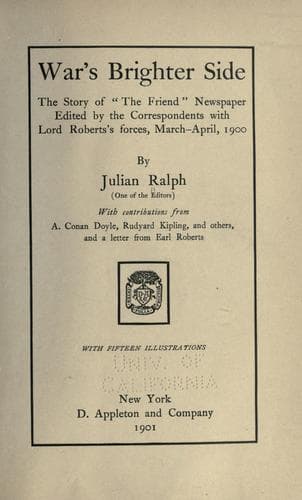
War's Brighter Side: The Story of The Friend Newspaper Edited by the Correspondents with Lord Roberts's Forces, March-April, 1900Ralph, Julian
History
War's Brighter Side: The Story of The Friend Newspaper Edited by the Correspondents with Lord Roberts's Forces, March-April, 1900
Ralph, Julian
Friend (Bloemfontein, South Africa); South African War, 1899-1902 -- Periodicals
Miss Bloemfontein was not alone in disliking to recognise the presence
of the British army. Her mother was not the only person who could not
bear to see Englishmen marring the scenery of the pest-ridden little
town. Even while the tricky among the people joined in singing
"Soldiers of the Queen," one man in the crowd turned to a war
correspondent and said, "You English are strutting about very proudly
and confidently, and think you own the country, but when you go away
from here you will be sniped at from every bush and spruit wherever
you show yourself."
I took a little walk up past the English Cathedral one day and saw a
woman seated upon her front _stoep_, sewing. "Good morning," said I,
"do you speak English?" She rose and glared at me with scorn in her
eyes. "No," said she, "but I hate the English."
A little girl ran out of a doorway a few houses farther along and
called to me, "Mister, mister! Please wear the red, white and blue,"
and she pinned a knot of the British and American colours on my coat
lapel.
"What sort of a lady is it who lives in that house?" I asked; "she
says she hates the English."
"Oh, she is Dutch," the little girl replied; "almost everybody here
hates you."
I turned a corner and went down a side-street. Two young women in a
doorway beamed upon me. I was out to study the town and the people, so
I halted and engaged them in conversation. One was married, and her
husband, who was of English stock, had cleverly managed to be away
when the war broke out, after which he found it impossible to return
and join a Boer commando as he would have had to do, being only a poor
working man.
"We are on the police books as English sympathisers," said one of the
women. "We have had to be very careful, as we were warned that if we
gave further offence we would be punished. What happened was this: You
see the town is full of Germans, who have been most bitter against the
English. We went to the railway station when some English prisoners
were being sent to Pretoria. As the train moved off we waved our hands
to them and wished them better luck. A German saw us do it, and
reported us to the authorities, so we were taken up and examined, and
had our names put in the 'black-book.'"
A score of the honest people of the town who had been avowedly true to
their English blood, which was by no means the case with all the
British Uitlanders, told me that they suffered petty persecution all
the time until the town was captured. Note what "Miss Uitlander" said
in her reply to "Miss Bloemfontein" in THE FRIEND of March 26th:--
The "loving hand" you boast of having extended to us has
long since been covered by an iron glove, the weight of
which we have daily been made to feel, and to _that_ you
must associate the joyful flaunting of our colours in your
face. His coming meant freedom--the sweetest thing in the
world--to us.
Public-domain text, read in full here on John Shaqi.
Reviews
Reviews
No reviews yet
Be the first to share your thoughts on this work.
Elsewhere in the archive
Join the Discussion
Join the discussion
Sign in to leave a comment or review.
Sign InorCreate an account