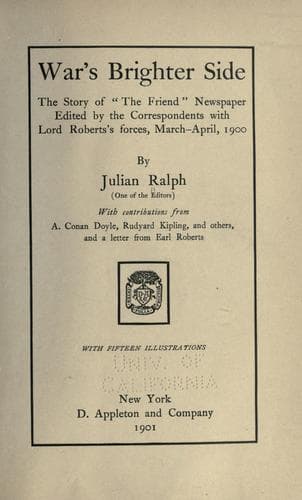
War's Brighter Side: The Story of The Friend Newspaper Edited by the Correspondents with Lord Roberts's Forces, March-April, 1900Ralph, Julian
History
War's Brighter Side: The Story of The Friend Newspaper Edited by the Correspondents with Lord Roberts's Forces, March-April, 1900
Ralph, Julian
Friend (Bloemfontein, South Africa); South African War, 1899-1902 -- Periodicals
With this by way of preface, will the _Times_ accept our apology for
not crediting it with Mr. Kipling's article, will it believe us that
we really did write in the "credit" after the article, and will it
commission its correspondent with this Army to go to our printing
works and reason with our printers from "the devil" upwards?
* * * * *
THE WAR ARTIST OF TO-DAY.
BY H. OWEN SCOTT.
The present campaign has undoubtedly commenced a new era in
the history of illustrated journalism, which change has been
brought about by a new school of war artists, whose method
is camera work, and whose aim is to faithfully produce the
actualities demanded by a picture-loving, yet critical
public.
The artistic value of this means of illustrating is becoming
more and more realised every day, and will prove an
effectual factor in crowding out the old-fashioned war
artist who draws on his imagination.
The only excuse for artists of any description being at the
front is their capacity for reproducing true and vivid
impressions of what they have seen.
This is where the importance of the new school is at once
apparent, and as long as the men practising this art are
honest and do not attempt to foist "faked" work on the
public, their efforts are bound to be acceptable and of
artistic value.
In speaking of camera work as an art and the individuals
adopting it as artists, I do not include the persons who
simply press a button and expose yards of film, regardless
of subject, but the few who make pictures intelligently and
pay as much attention to composition and lighting as a
painter would when commencing a fresh canvas. The camera is
not going to destroy the painter--and I say painter
advisedly--as no black and white artist is any good unless
he is a painter, and has a keen appreciation of colour
value. Nature is teeming with colour, and unless this is
felt how can it be suggested in line?
Why does Rembrandt stand out as the greatest master of
etchings? Simply because his etched works suggest colour,
and it is this power of suggesting colour that placed
Charles Keene head and shoulders above all other black and
white men. The power of selection of subject is not
developed in all artists to an equal extent, but there is
always room for such men as Melton Prior, W. B. Wollen,
Lester Ralph, and a few others, whose work will always be
looked for as representing actuality.
If the two schools of artists mentioned work with the full
knowledge of the limitations of their mediums, there will
always be a place for both.
The mechanical draughtsman is dead. He has been killed by
the camera.
Public-domain text, read in full here on John Shaqi.
Reviews
Reviews
No reviews yet
Be the first to share your thoughts on this work.
Elsewhere in the archive
Join the Discussion
Join the discussion
Sign in to leave a comment or review.
Sign InorCreate an account