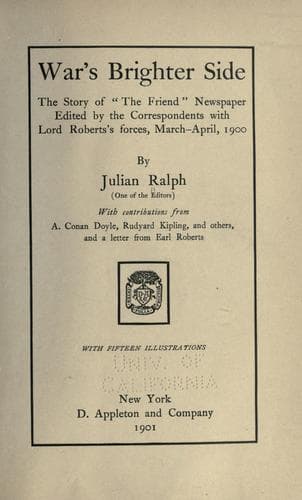
War's Brighter Side: The Story of The Friend Newspaper Edited by the Correspondents with Lord Roberts's Forces, March-April, 1900Ralph, Julian
History
War's Brighter Side: The Story of The Friend Newspaper Edited by the Correspondents with Lord Roberts's Forces, March-April, 1900
Ralph, Julian
Friend (Bloemfontein, South Africa); South African War, 1899-1902 -- Periodicals
As long ago before this as when Sir Alfred Milner was with us in
Bloemfontein, we had made known to him and to Lord Roberts, through
Lord Stanley, that the employers of certain ones among us were
complaining of our expending part of their time and our energy upon
this outside work. I am certain that no interest with which any of us
were connected suffered the least slight or injury, for the result of
our labour of love for Lord Roberts was simply that we worked twice as
hard--and learned twice as much of what was going on as those
correspondents who held aloof and let the whole burden fall upon us.
My employer, Mr. Harmsworth, uttered no sound of criticism or
complaint, by the way, and the only word about THE FRIEND that
reached me from the _Daily Mail_ was a cablegram wishing us success.
We were all tiring fast. I was lame with an injury which kept laying
me up, and otherwise my condition was such that for weeks I had not
been able to partake of any food except milk and soda water. I owe a
great deal for moral and physical stimulus to Dr. Kellner, ex-mayor of
Bloemfontein and head of the Free State Hospital, whose services to
the British army should not be allowed to pass into history without
his receiving some substantial honour and acknowledgment from this
government. He told the noble matron, Miss Maud Young, and her nursing
assistants (when they gave notice that they wished to leave at the
outbreak of the war) that he "never heard before that politics had
anything to do with the care of sick and wounded men," and up to that
standard of duty he worked on with them as enthusiastically under the
Union Jack as he had under the four-colour flag.
I did not know how ill and dispirited I was until one evening I went
to the room of my assistant, Mr. Nissen, of the DAILY MAIL, and heard
through his closed window in the Bloemfontein Hotel the sound of a
banjo. It is a purely American instrument, and the plunk-plunk of its
strings made my heart leap. I threw open the window and heard in nasal
tones, affected by a Yankee colleague for the purpose of his song, a
sentiment like this:--
Oh, I want ter go back to Noo York,
Ther "tenderloin's" ther place,
Where the men are square and the women are fair
And I know evurry face.
I want ter go back to Noo York
Ter hear Gawd's people talk.
Yer may say what yer please
Only just give ter me
My little old Noo York.
I felt like shouting, "fellow citizens, them's my sentiments."
Suddenly I, too, wanted "ter go back ter Noo York"--with London as an
alternative. I had not known it or felt it before, but that song, as
new to me as any that will be written five years hence, touched the
button that produced a nostalgia which Heaven knows I had good reason
to feel without any such additional or peculiar incentive.
Public-domain text, read in full here on John Shaqi.
Reviews
Reviews
No reviews yet
Be the first to share your thoughts on this work.
Elsewhere in the archive
Join the Discussion
Join the discussion
Sign in to leave a comment or review.
Sign InorCreate an account