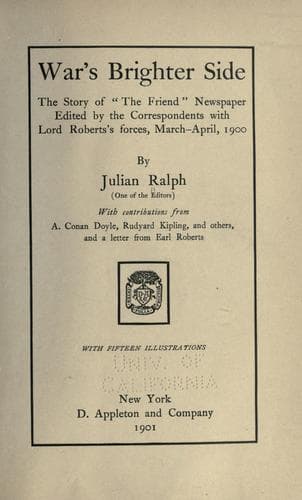
War's Brighter Side: The Story of The Friend Newspaper Edited by the Correspondents with Lord Roberts's Forces, March-April, 1900Ralph, Julian
History
War's Brighter Side: The Story of The Friend Newspaper Edited by the Correspondents with Lord Roberts's Forces, March-April, 1900
Ralph, Julian
Friend (Bloemfontein, South Africa); South African War, 1899-1902 -- Periodicals
"THE FRIEND" was an afternoon paper published at three or four or five
o'clock in the evening, according as the Dutch compositors chose to
get it out. We editors went to our tiny editorial room between nine
and ten o'clock in the morning, and worked until lunch time--one
o'clock--writing, seeing visitors, correcting proofs, and reading
manuscripts. What I have called "seeing visitors" mainly consisted in
turning away private soldiers who came for copies of the paper. Though
we posted notices that ours was the editorial room, and that papers
were to be had at Barlow's stationery shop, "Tommy" would insist upon
coming to us; therefore we gave up a large part of our time to sending
him away, now yelling at him, now bursting into expletives, and anon
pleading most politely that we were neither newsboys nor railway
bookstall keepers.
What I have called "reading manuscripts" was largely the work of
examining the poetry of this same Mr. Atkins, who, fired by the genius
of Mr. Kipling, is sometimes a better poet than you would think,
sometimes a worse poet than you can imagine, but is generally a
poet--of one sort or another.
We had good "Tommy" poets in our ranks; wherefore, when Mr. Kipling
came, he insisted that all soldier poetry should be religiously read,
and the best of it published. He pored over miles of it. At the idea
of re-writing and improving Tommy's verse he was pained, and when Mr.
James Barnes, on one occasion, spent half a day in putting a "Tommy"
poem into Queen's English, Mr. Kipling was righteously indignant, and
spent an hour in getting it back to Tommy's vernacular. But we are
coming to Mr. Kipling presently.
The rest of the time of all except the man who wrote the leader of the
day was spent in correcting the typographical errors of the Dutch
compositors, who, by the way, could make more numerous and more
dreadful mistakes in type than ever an intelligence officer made in
getting news of the enemy. The consequence was that we often took up
the first paper that reached us from the presses, and with a sigh
assured each other that it was almost wholly given up to bad verse and
printers' errors.
Public-domain text, read in full here on John Shaqi.
Reviews
Reviews
No reviews yet
Be the first to share your thoughts on this work.
Elsewhere in the archive
Join the Discussion
Join the discussion
Sign in to leave a comment or review.
Sign InorCreate an account