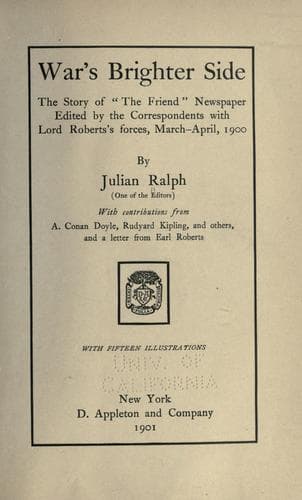
War's Brighter Side: The Story of The Friend Newspaper Edited by the Correspondents with Lord Roberts's Forces, March-April, 1900Ralph, Julian
History
War's Brighter Side: The Story of The Friend Newspaper Edited by the Correspondents with Lord Roberts's Forces, March-April, 1900
Ralph, Julian
Friend (Bloemfontein, South Africa); South African War, 1899-1902 -- Periodicals
At noon during these early days one of us would gather up all the
proofs that we could get from the printers, and march over to Lord
Stanley's office to have them censored. He was so considerate and
liberal that this soon proved a mere formality. I think he must have
regarded the eccentric but interesting journal as a child of his own,
or at least as one whose parentage he would be too polite to dispute
if Lord Roberts claimed it. We used to hear how very much the great
Field Marshal, also, was interested in it; how eagerly he secured his
copy every day, and how much he liked all that it contained. A visitor
at the Residency told us that one afternoon Lord Roberts saw an
officer reading THE FRIEND, and called to one of his staff: "I see a
man in there reading THE FRIEND. How is it I have not had my copy?"
The officer's paper proved to be a copy of an earlier number, so that
the Field Marshal's wounded pride was healed. But we liked that story;
we liked it very much indeed.
Our fifth number, published on March 21st, began with Mr. Gwynne's
hearty leader on Rudyard Kipling, who was expected to reach
Bloemfontein on that day. Mr. Gwynne also wrote one of his
characteristic satirical articles on "The Soberest Army in the World."
Mr. Landon contributed a lively and picturesque narrative of the
principal feat our despatch riders had performed up to that time, and
I perpetrated a modest bit of reporting on South Africa's
attractions--an article of greater interest here and now than it was
then and for our army readers.
We had made it known that private soldiers would be charged only a
penny for the paper, the original threepence being demanded solely of
officers. In this way we hoped to earn a greater profit than by
shutting out of our trade the humble private, to whom a threepence (a
"ticky," as it is called in Africa) sometimes appears as big as a
cart-wheel. But our new plan brought us a lot of trouble--especially
of the kind you feel when you know you are being done out of something
and yet cannot help yourself. The fact was that the officers encamped
at a distance sent in their servants for their papers, and these
messengers, being privates, only paid a penny for each paper. Then,
again, the officers were dressed so nearly like the men that the
newsboys and assistants in Barlow's shop could not distinguish them
apart, and charged many of the officers the penny of the private. This
annoyed us, because we were intent upon making as much money as
possible in order to turn over a handsome sum to a soldier charity
when we should end our stewardship--for not a penny did we mean to
keep for ourselves. Mr. Landon wrote a strenuous appeal to the
officers to help us to get our just dues. To the same paper Mr. A. B.
Paterson, of the _Sydney Herald_, contributed a very clever bit of
verse, entitled, "Fed up." He was one of the contributors of whom we
were most proud--and justly so.
Public-domain text, read in full here on John Shaqi.
Reviews
Reviews
No reviews yet
Be the first to share your thoughts on this work.
Elsewhere in the archive
Join the Discussion
Join the discussion
Sign in to leave a comment or review.
Sign InorCreate an account