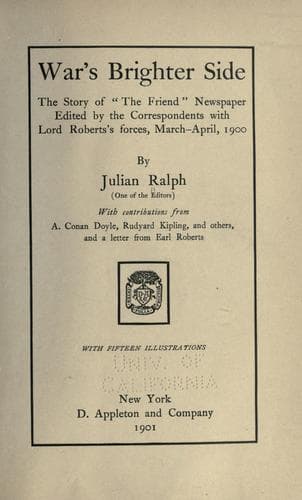
War's Brighter Side: The Story of The Friend Newspaper Edited by the Correspondents with Lord Roberts's Forces, March-April, 1900Ralph, Julian
History
War's Brighter Side: The Story of The Friend Newspaper Edited by the Correspondents with Lord Roberts's Forces, March-April, 1900
Ralph, Julian
Friend (Bloemfontein, South Africa); South African War, 1899-1902 -- Periodicals
But the London papers published the full account of the surrender on
the second day after the capitulation.
The manner in which news was sent to the English papers may perhaps
be of interest. It must be remembered that there was then no
communication with the south. It was impossible to pick up the cut
wire north of Norval's Pont. The line from Kimberley to Boshof lies,
even as we write, in a cat's cradle on the veldt. There was no
option--the telegrams must be sent through Kimberley and by despatch
riders.
Perhaps it is truer to say that one or two London papers did so, for a
certain number relied--and with justice--on the recuperative powers of
Captain Faussett and his myrmidons of the wire.
To ride a hundred miles across the veldt against time, and against at
least two other competing riders, through the enemy's country, and at
a moment's notice, is not the least exciting occupation that can be
chosen by a light-weight searching for a new sensation.
It combines the certainty of hardship and discomfort with the
possibility of being shot; and over and above all is the pressing need
of saving every minute of time.
Three despatch riders set out from Bloemfontein during the evening of
Tuesday or the earliest dawn of Wednesday. First in order of starting
was the _Times_ messenger, second that of Reuter's Agency, third came
the "angelos" of the _Daily Mail_.
From Bloemfontein to Kimberley is, as we have said, a distance of a
hundred miles. It is best understood by a Londoner by suggesting the
comparison that he should be compelled to ride to Hereford every time
he wished to despatch a telegram.
Out from the isolated city the messengers went, making their way in
the darkness or in the dawn over the red slushing tracks that had
suffered the steady downpour of the night's rain, till, by whichever
road they had moved out of Bloemfontein, they met at the battle-ground
of Driefontein.
From that point onwards the struggle became keen, and the breakdown of
a horse meant a delay that might perhaps be reckoned in days rather
than hours. The public that glances casually at the telegrams of their
morning papers does not often realise the importance of a few minutes
to the correspondents whose work they are reading. In this case,
besides the ordinary delay, the lonely riders that were making way
across the veldt had to spur them on the risk of finding the Field
Telegraph repaired before they could reach the Diamond City, and the
cable blocked with messages sent over their heads from Bloemfontein.
Early in the great race the _Times_ rider met with disaster. The horse
he rode fell, and, though the injury seemed slight enough at the time,
never properly recovered itself, causing a delay of some hours before
the next relay could be reached.
Public-domain text, read in full here on John Shaqi.
Reviews
Reviews
No reviews yet
Be the first to share your thoughts on this work.
Elsewhere in the archive
Join the Discussion
Join the discussion
Sign in to leave a comment or review.
Sign InorCreate an account