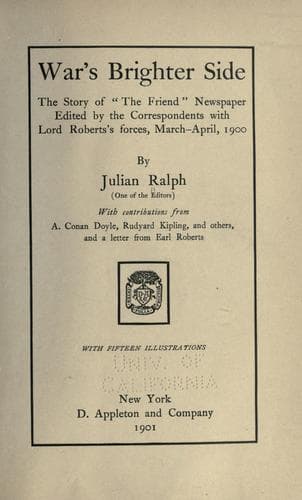
War's Brighter Side: The Story of The Friend Newspaper Edited by the Correspondents with Lord Roberts's Forces, March-April, 1900Ralph, Julian
History
War's Brighter Side: The Story of The Friend Newspaper Edited by the Correspondents with Lord Roberts's Forces, March-April, 1900
Ralph, Julian
Friend (Bloemfontein, South Africa); South African War, 1899-1902 -- Periodicals
There went to the stalwart and kindly Prince one day an artist who
said he desired to surrender two mules which did not belong to him. It
was not the truth that he desired to give them up, nor was it out of
politeness that he told the falsehood. The fact was that the army had
taken his horses and left him a pair of feeble, poorly animated steeds
of the clothes-horse pattern, which gave out on the long road between
Poplar Grove and Bloemfontein. At the same time two healthy mules,
astray on the veldt, evinced a yearning for human companionship, and
insisted upon intruding themselves upon the company of the artist and
his Basuto servant while they were preparing lunch. To go on with his
own weak and sick animals was to invite a loss of locomotive power in
a country infested with Boers. To make use of the fresher mules was
the natural and obvious alternative. Therefore the artist abandoned
his horses and went on with the mules. Arrived in Bloemfontein, he at
once continued his travels by joining the "bill-sticking expedition"
of General French over to Thaba N'chu and the region beyond.
"Bill sticking," by the way, was how the officers nicknamed the
distribution of copies of Lord Roberts' proclamation calling on the
Boers to lay down their arms and sign a promise not to continue the
war. When the artist returned to Bloemfontein he was met by friends
who said that he would certainly be shot if he was found to be using
animals that did not belong to him. Lord Roberts had grown angry, it
was said, and had exclaimed aloud that no matter who or what the man
might be, the next offender in this respect should be shot. It was
this stentorian cry, and not the still, small voice of conscience,
that sent the artist to the Prince, to whom he told the truth and made
formal surrender of the mules.
"And very nice indeed it is of you," said the Prince, "very honest and
straightforward. I will send some one to get the mules this
afternoon."
"But, I beg pardon," said the artist, "now everything's all right,
isn't it? The mules were not mine, and I have surrendered them, and
there's no trouble to follow?"
"No, indeed," said Prince Francis, "I am much obliged to you. Animals
are very scarce and we need all we can get; so very good of you to do
as you have done."
"Well, now," said the artist, "won't you please let me keep the mules?
The Army stole my horses and left me a broken-down pair. I had to turn
them loose and take these mules or I should have been killed or
captured by the Boers. I have nothing else to move on with. I wish you
would let me keep the mules."
"Really," said the Prince, "I cannot do that. I never heard such a
proposition in my life. I have no authority to do as you ask. Upon my
word, this is most extraordinary. Come, I'll tell you what I will do.
I'll see that you get a pair of animals at the Army price. I can't
sell them to you or buy them for you, but I can have a pair put aside
for you to buy of somebody who brings them in to sell."
Public-domain text, read in full here on John Shaqi.
Reviews
Reviews
No reviews yet
Be the first to share your thoughts on this work.
Elsewhere in the archive
Join the Discussion
Join the discussion
Sign in to leave a comment or review.
Sign InorCreate an account