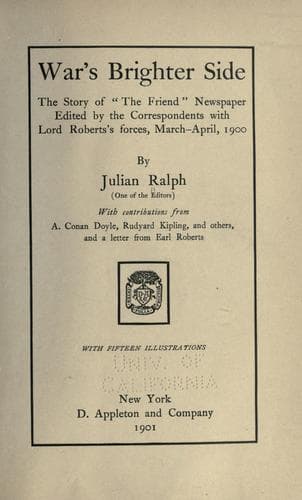
War's Brighter Side: The Story of The Friend Newspaper Edited by the Correspondents with Lord Roberts's Forces, March-April, 1900Ralph, Julian
History
War's Brighter Side: The Story of The Friend Newspaper Edited by the Correspondents with Lord Roberts's Forces, March-April, 1900
Ralph, Julian
Friend (Bloemfontein, South Africa); South African War, 1899-1902 -- Periodicals
Dear careless bhoys that laughed and died
By kopje and fontein--
Our dead that won the living prize--
The Wearin' of the Green!
RUDYARD KIPLING.
[_Copyright in England and the U.S.A._]
* * * * *
MILITARY LAW.
(_Editorial._)
In times like the present when military matters are discussed by all
classes of society, both by soldiers and civilians, the question of
the law, by which discipline and law, not only among the troops, but
also the civil population in the country they occupy are maintained,
frequently arises, and the terms "Martial Law" and "Military Law" are
often made use of as if they meant the same thing. It is to explain
this that the following is written.
"Military Law" is the Law which governs the soldier in peace and in
war, at home and abroad. It is administered under the Army Act which
is part of the Statute Law of England, and which, by special
provision, must be brought into, and continue in force, by an annual
Act of Parliament.
With an army in the field, certain persons, not soldiers, are also
subject to the provisions of "Military Law," such as civilians serving
with the force in an official capacity; persons accompanying the
troops with special leave, such as newspaper correspondents and
contractors; persons employed with the troops, such as transport
drivers; other persons known as followers who accompany the troops
either as sutlers or on business or pleasure with the permission of
the commander.
"Martial Law," on the other hand, is only operative in war. It is in
fact no law at all, and has been accurately defined as the "will of
the conqueror." The expression "Customs of War" would perhaps better
define what is meant by "Martial Law," because the word Law conveys
the idea to most people of an enactment containing a fixed and rigid
rule which must be obeyed, and which, if disobeyed, will involve
punishment.
This "Law" or "Custom" is applicable to all persons and inhabitants
not subject to "Military Law" residing within the foreign country or
that portion of it occupied by the troops, and also within districts
under British rule abroad, which, in consequence of riot or rebellion,
are so declared to be subject to "Martial Law" by proclamation.
It will thus be seen that a commander of troops in time of war acts in
two distinct capacities. First, he governs the troops by "Military
Law" only; secondly, in his position of governor of the country he
occupies, he imposes such laws or rules on the inhabitants as in his
opinion are necessary to secure the safety of his army, and also the
good government of the district which, by reason of the war or
rebellion, may for the time have been deprived of its ordinary rulers
and the machinery for maintaining order.
Public-domain text, read in full here on John Shaqi.
Reviews
Reviews
No reviews yet
Be the first to share your thoughts on this work.
Elsewhere in the archive
Join the Discussion
Join the discussion
Sign in to leave a comment or review.
Sign InorCreate an account