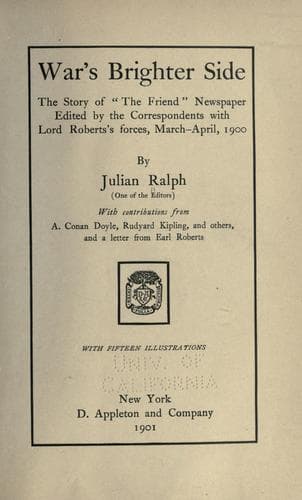
War's Brighter Side: The Story of The Friend Newspaper Edited by the Correspondents with Lord Roberts's Forces, March-April, 1900Ralph, Julian
History
War's Brighter Side: The Story of The Friend Newspaper Edited by the Correspondents with Lord Roberts's Forces, March-April, 1900
Ralph, Julian
Friend (Bloemfontein, South Africa); South African War, 1899-1902 -- Periodicals
Army experts waited for the results of the use of long-range magazine
rifles, smokeless powder, and high explosives, yet trenches and hills
defended by men with Mausers were stormed and taken by men with
Krag-Jorgensens in their hands in the old-fashioned way--a steady
advance and a rushing charge to clinch it. Caney and San Juan Hill
were old-fashioned fights with the exception of the fact that men were
killed miles in the rear by the straying droves of bullets and never
saw an enemy.
As in this war the losses did not compare to those of some
hand-to-hand conflicts of the Rebellion, and many wounds that in the
old days would have proved fatal, thanks to the merciful Mauser,
amounted to very little. Perhaps to offer explanation of some strange
occurrences of the Cuban war would be disparaging to the Spaniards.
Perhaps the least that can be said is that in the main the Dons were
shocking poor shots, and they had been so weakened by disease and
hunger that they had not much fight left in them when it came to cold
steel and clubbed muskets. The great losses in Cuba were from fevers,
not from bullets. It is in the conditions and environments that the
chief difference lies between the war here and the war over there. And
it is from this present conflict that the world will learn. The
Philippine war, costly as it was in life and money, was nothing but a
series of victories over a half-civilised enemy. The interest in it in
America, strange to say, dwindled to little or nothing after the first
gunshot in South Africa.
Here was a different state of affairs. Cuba (for Puerto Rico was a
"walk over") was a country full of dense forests and tangled
undergrowth, offering a screen as well as a hindrance to the movements
of an army. South Africa is the greatest defensive country in the
world, and the Boer is trained by nature and inheritance to make the
best of it. Yet it took time to teach some of the English military
leaders to adapt themselves to the new conditions--it was hard for
them to break away from the traditions of Waterloo and Badajos. The
Mauser began to correct the old ideas of warfare in a way that it had
failed to do in Cuba. The prophecies in Bloch's remarkable book were
fulfilled almost to the letter. Proper scouting in an open country is
a dead department of military service. How long did we lie at Modder
River without knowing anything of value of the movements of the enemy?
A series of kopjes might conceal a few sharpshooters or an army--at a
mile's distance scouts were under the fire of an invisible foe. A good
shot ensconced between sheltering rocks discounted four men advancing
in the open. In Cuba the American troops were harassed by marksmen
concealed in tree-tops who often fired upon them from the rear, but
the forces opposed to them in front were mostly infantry, and the
problem resolved itself into a contest between individual soldiers as
fighting units. It was a soldiers' conflict.
Public-domain text, read in full here on John Shaqi.
Reviews
Reviews
No reviews yet
Be the first to share your thoughts on this work.
Elsewhere in the archive
Join the Discussion
Join the discussion
Sign in to leave a comment or review.
Sign InorCreate an account