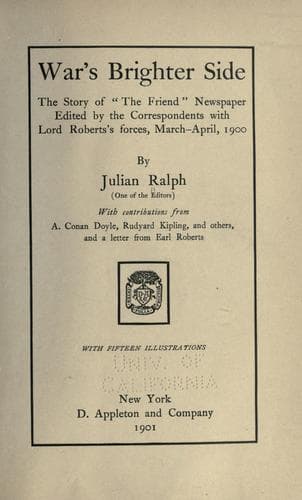
War's Brighter Side: The Story of The Friend Newspaper Edited by the Correspondents with Lord Roberts's Forces, March-April, 1900Ralph, Julian
History
War's Brighter Side: The Story of The Friend Newspaper Edited by the Correspondents with Lord Roberts's Forces, March-April, 1900
Ralph, Julian
Friend (Bloemfontein, South Africa); South African War, 1899-1902 -- Periodicals
So, at last in desperation, this most simple-minded elf,
He thought he'd do a little commandeering for himself;
And the first thing that he noticed was a bottle on a shelf
In a cottage, so he thought he'd commandeer it.
"What ho!" says he, "a bottle! and, by George, it's full of beer!
And there's no commandin' officer to come and interfere.
So here's my bloomin' health," says he; "I'm on the commandeer."
And without another word he commandeered it.
ANONYMOUS.
* * * * *
SIR WILLIAM LOCKHART.
BY SIR WILLIAM NICHOLSON, K.C.B.
Sir William Lockhart's death, as recently announced in Army Orders,
will be deeply deplored by his many friends in the Army in South
Africa. It was known that he had been seriously ill last September,
but he had seemingly recovered when he visited Burma in December. On
his return to Calcutta in January, symptoms developed themselves which
caused great anxiety, and, although he telegraphed to the effect that
he hoped soon to be all right again, the end was not far distant.
Apart from his ability as a soldier and administrator, Sir William
Lockhart endeared himself to all who had the privilege of his personal
acquaintance by his charming manners, his genial hospitality and his
kindness of heart. Born in 1842, he joined the Indian Army in 1858,
and during the Mutiny he was attached to the 7th Fusiliers. He
afterwards served with the 26th Punjab Infantry, the 10th Bengal
Lancers, and the 14th Bengal Lancers. He was employed on the Staff in
the Abyssinian Expedition.
When the Acheen War broke out he was attached to the Headquarters of
the Dutch Force, where he made himself extremely popular. It was
interesting to hear him describe the Dutch method of fighting, which,
as might be imagined, led to no decisive result. The climate being
tropical, the Dutch would only attack the enemy in the early morning;
the rest of the day being spent in camp. The enemy were more active,
and caused the Dutch much annoyance by frequently disturbing their
afternoon siesta. As no means of transport were asked for or provided,
the campaign was of a purely defensive nature, and at the end of it
things were virtually in the same state as at the beginning.
Public-domain text, read in full here on John Shaqi.
Reviews
Reviews
No reviews yet
Be the first to share your thoughts on this work.
Elsewhere in the archive
Join the Discussion
Join the discussion
Sign in to leave a comment or review.
Sign InorCreate an account