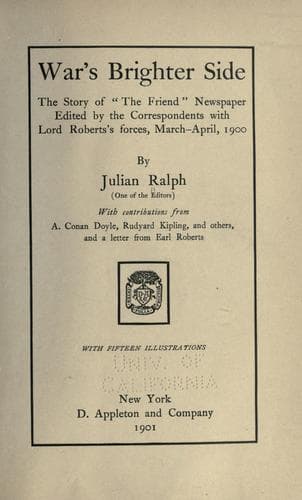
War's Brighter Side: The Story of The Friend Newspaper Edited by the Correspondents with Lord Roberts's Forces, March-April, 1900Ralph, Julian
History
War's Brighter Side: The Story of The Friend Newspaper Edited by the Correspondents with Lord Roberts's Forces, March-April, 1900
Ralph, Julian
Friend (Bloemfontein, South Africa); South African War, 1899-1902 -- Periodicals
In April, 1895, the Presidential Armies were broken up and the Army
Corps System was introduced, Sir William Lockhart being nominated to the
command of the Forces in the Punjab. In this appointment he displayed
administrative talents of a high order, his main object being to
decentralise responsibility and authority, and to diminish office work
and official correspondence. It was in a great measure due to his
efforts in this direction that the new system worked so smoothly. When
he became Commander-in-Chief he kept the same end in view by granting
the fullest possible powers to the Lieutenant-Generals of the four
Commands and to the General Officers commanding Districts, and by
insisting on their making use of those powers to the fullest extent.
In March, 1897, Sir William Lockhart went home, having been advised to
undergo a course of treatment at Nauheim. Meanwhile, disturbances took
place along the North-West Frontier, which culminated in an outbreak
of the Orakzaia and Afridis, and the capture by the latter of our
posts in the Khyber Pass. In September he was hurriedly recalled to
India for the purpose of commanding the Tirah Expeditionary Force.
This is not the place to discuss the operations in Tirah, which were
much criticised at home. The fact is that the British public had
become so accustomed to almost bloodless victories over savage enemies
that they failed to appreciate the extraordinary difficulties of the
Afridi country, and the advantages to the defence which the possession
of long-range rifles and smokeless powder confers. Moreover, there are
no better marksmen in the world than the Afridis, who are born
soldiers, and the mobility of hardy mountaineers in their native hills
necessarily exceeds that of regular troops encumbered with baggage and
supplies.
Anyhow, the result of the expedition fully justified the choice of its
commander. The Afridis acknowledged themselves to be thoroughly
beaten; and Sir William Lockhart's tact in dealing with them after
they had submitted has led to the re-establishment of friendly
relations between them and ourselves on a firmer basis than before.
What their present attitude is may be judged from the fact that Yar
Mahomed, the head of the Malikdin Khels, recently petitioned the
Government of India to be allowed to raise 1,500 tribesmen for service
in South Africa.
On the conclusion of the Tirah campaign Sir William Lockhart took
leave to England, and came out again as Commander-in-Chief in India in
November, 1898. He died on the 18th of March, 1900. In him, as Lord
Roberts has remarked in his Army Order of the 20th inst., "the
soldiers in India have lost a friend, and the Indian Empire a trusted
counsellor who cannot soon or easily be replaced."
Public-domain text, read in full here on John Shaqi.
Reviews
Reviews
No reviews yet
Be the first to share your thoughts on this work.
Elsewhere in the archive
Join the Discussion
Join the discussion
Sign in to leave a comment or review.
Sign InorCreate an account