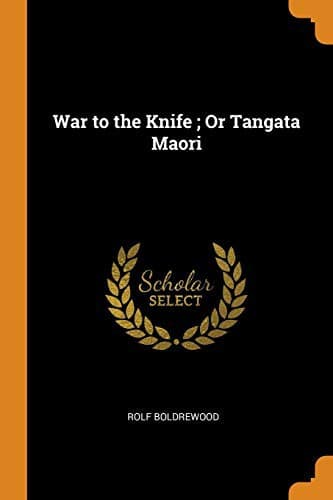
"War to the Knife;" or, Tangata MaoriBoldrewood, Rolf
General
"War to the Knife;" or, Tangata Maori
Boldrewood, Rolf
Māori (New Zealand people) -- Fiction; New Zealand -- Fiction
Thus, when she arose next morning and commenced to busy herself about
the indispensable duties of the household, she experienced a feeling
of relief to which she had been long a stranger. The day was fine, the
clouds of heaven had disappeared, it would seem, simultaneously with
those of her spirit. As in the Northern Britain, with its frequent rain
and hail, mist and snow, this rare day, on which the disturbing forces
of the elements held truce, was inexpressibly lovely. The mountain
snow-crown was revealed in all its purity and austere majesty, a
silver diadem against the blue and lustrous heavens. The fruit trees
in the garden, the oaks and elms, poplars and walnuts, planted in fond
remembrance of the dear old home-land, seemed bursting into redundant
greenery. The river rippled and murmured under its o'er-arching ferns,
and as the little band of dark-skinned children, with their glancing
eyes and smiling faces, all obedient and cheerful, passed on to the
modest building, wherein they were daily so patiently taught by their
pastor and his wife, she could hardly refrain from expressing her
thankfulness for the success of this single-hearted enterprise, in
which she had been deemed worthy to share.
That the wave of barbaric warfare might at any moment sweep over the
peaceful scene, leaving ruin and desolation in its track, seemed, in
the glory of that beauteous morn, incredible and preposterous. During
later musings, however, when the routine business of the little school
failed to absorb her attention, the thought would obtrude itself
of the strange complication of affairs which would arise if, as was
rumoured, Roland was about to marry this half-savage girl, as she could
not but consider her. Beautiful she was by all report, devoted she must
have been to her white lover, educated to a certain extent, and, in
virtue of her father's lands granted in earlier times, an heiress of
considerable pretensions. But----! She well knew what a death-in-life
it would be considered by his English friends. Of course, it was far
from improbable. Younger sons and others of aristocratic British
families had married these fascinating half-caste girls, even those
of pure Maori blood. This she knew from authentic sources. In this
distant land, so far from British social edicts, such a marriage was
not looked upon as a _mésalliance_. And if such should be his lot, who
would have been the dominant factor in thus shaping his destiny? Who
but herself, unwilling, doubtless, but none the less the primary agent
in his deportation, his colonial career, with its risks, dangers, and
this irrevocable lapse--finally, his absorption in a different class
and an alien race? She felt minded to groan aloud. Why should she have
been selected to work all this misery and ruin, ending, perhaps, in
death? Why could she not foresee the direful consequences flowing from
his fatal _entrainement_?
Public-domain text, read in full here on John Shaqi.
Reviews
Reviews
No reviews yet
Be the first to share your thoughts on this work.
Elsewhere in the archive
Join the Discussion
Join the discussion
Sign in to leave a comment or review.
Sign InorCreate an account