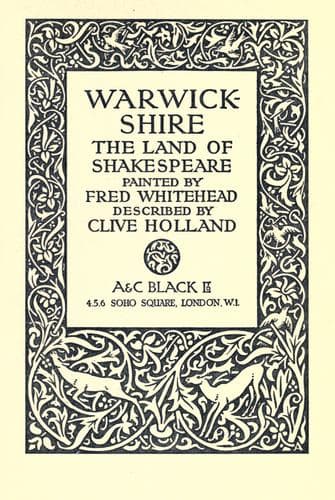
Warwickshire: The Land of ShakespeareHolland, Clive
History
Warwickshire: The Land of Shakespeare
Holland, Clive
Warwickshire (England) -- Description and travel
The last of the De Clintons of Maxstoke was also a soldier, who had
the misfortune to be captured in the French war and to suffer a long
term of imprisonment. Humphrey, Earl of Stafford, the new owner of
Maxstoke, who was made a Knight of the Garter in 1429, and was created
Duke of Buckingham in 1444, was Lieutenant Governor of Normandy and
Calais, and Ambassador to France. He had also another distinction
conferred upon him, that of precedence before all other Dukes who might
thenceforward be created, excepting only descendants of the King.
He was a warm supporter of the Lancastrian cause and, owing to his
marriage with Margaret Beaufort, daughter and heiress of Edmund Duke
of Somerset, was related to the Royal House. He fell at the battle
of Northampton, July 10, 1460, when leading the Lancastrian forces,
one of his sons having been killed at the battle of St. Albans five
years previously; and he proved on his death a great benefactor to the
destitute poor, some of whom he directed should carry tapers at his
funeral, and pray for the repose of his soul.
[Illustration: SHAKESPEARE’S BIRTHPLACE.]
It was Buckingham who strengthened the oaken doors of Maxstoke by
sheets of iron bearing his arms and supporters, and also the “burning
nave and knot,” which was the ancient badge of the house.
It does not appear that Buckingham made Maxstoke by any means his chief
residence, but the names of many of the constables he appointed, and of
those who came after him, have been placed on record.
The castle and estates were forfeited by the second Duke and have had
during its history many owners.
The dwelling–house occupies the north–west angle of the inner court.
It is a partly timbered house, the front portion having been rebuilt
in the seventeenth century, and some changes have been made since that
date.
At the south end of the Great Hall was formerly the chapel, the west
window of which, in the late Decorated period, still remains. The
kitchen was somewhat strangely placed adjoining this, and communication
between it and the hall must have been carried on across the chapel,
the lower part of which is nowadays used as a butler’s pantry, and the
upper part a corridor to the Great Hall. In the chapel the marriage of
John Talbot, afterwards Earl of Shrewsbury, and Catherine, daughter of
the Duke of Buckingham, took place in 1457.
The great Baronial Halt, with a dais at one end, is on the first
floor, and forms a handsome apartment lighted by three windows. On
the west side there is a fine carved mantelpiece of coloured stone,
ornamented with the numerous quarterings of the Dilke family, and
bearing the following quaint inscriptions:—
Pennatus Sidera Morte
Where no woode is, No tale–bearers,
Ye fire goeth out; Strife ceaseth.
Public-domain text, read in full here on John Shaqi.
Reviews
Reviews
No reviews yet
Be the first to share your thoughts on this work.
Elsewhere in the archive
Join the Discussion
Join the discussion
Sign in to leave a comment or review.
Sign InorCreate an account