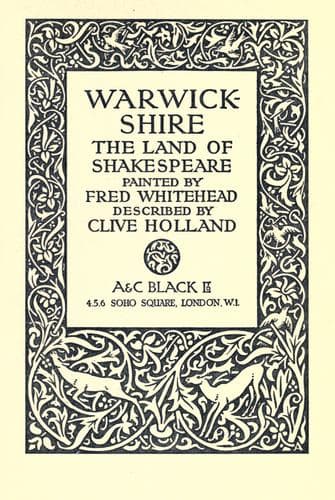
Warwickshire: The Land of ShakespeareHolland, Clive
History
Warwickshire: The Land of Shakespeare
Holland, Clive
Warwickshire (England) -- Description and travel
Next to this room is the bed–chamber occupied by Henry VIII. when
visiting the house, and containing a window in which is some old
painted glass. In one of the lights is a Tudor rose intact, and in
others there are portions of the arms of Catherine of Aragon. The
ceiling, which is interesting and curious, was probably made in the
reign of Charles I., and contains the arms of the various royal guests
who had honoured the house with their presence, including Henry VIII.,
Queen Elizabeth, James I., and Charles I.
The Council Chamber in the great tower is reached by a circular
staircase, and is notable for its beautiful split oak panelling,
exhibiting the grain of the wood in a manner impossible where sawn
timber is used. In a small chamber adjoining is a well–hole, probably
once forming the entrance to a secret passage communicating with a
trap–door in the north wing.
There were in ancient times a large number of secret hiding–places
at Compton Wynyates. Next but one to the room of Henry VIII. is a
chamber from which there was communication with a secret hiding–place
of quite considerable dimensions, reached from it by a stairway of
eleven steps only 19 inches wide. In this stairway is an “observation
hole,” some 10 inches high and about 2–1/2 inches wide, formerly
concealed by the panelling, by means of which the approach of the enemy
or of a search party could be watched by the fugitive in hiding. The
secret chamber is about seven feet square, and has two windows and a
small fireplace. One of the distinguishing features of the house is
the number of its windows and chimneys; a circumstance that made it
extremely difficult for searchers to locate any secret hiding–place,
even though furnished with both. Few manor–houses have, or at least
had, more numerous places of concealment great and small than Compton
Wynyates. In the south–western turret is another hiding–place, stated
to have been discovered by Lady Frances Compton about 1770, whilst she
was playing there as a child. The story goes that she fell against the
plaster–work which concealed the door, and the hollow sound emitted
caused investigation to be made. Upon opening the chamber it was found
(so tradition states) to contain the skeletons of a woman (a nurse?)
and two children, concealed, it is supposed, at some period of trouble
and forgotten.
Public-domain text, read in full here on John Shaqi.
Reviews
Reviews
No reviews yet
Be the first to share your thoughts on this work.
Elsewhere in the archive
Join the Discussion
Join the discussion
Sign in to leave a comment or review.
Sign InorCreate an account