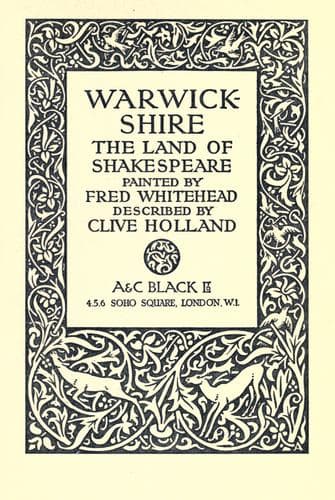
Warwickshire: The Land of ShakespeareHolland, Clive
History
Warwickshire: The Land of Shakespeare
Holland, Clive
Warwickshire (England) -- Description and travel
The history of the town subsequent to this date until the reign of
Edward VI. is very obscure. Indeed, although it is more than probable
that it saw something of the Wars of the Roses, and in a measure
played its part in the history of the county at large, the records
of its progress and the doings of its inhabitants are scanty indeed.
The name of one family, however, which became indissolubly connected
with Stratford towards the close of the fifteenth century, calls for
at least a passing mention. In 1483 Sir Hugh Clopton, of the manor of
Clopton, which lies about a mile to the north of Stratford, came to
the town and built himself a fine house (as houses were so considered
in those days) on the site now occupied by New Place. It was he that,
seeing the old bridge of wood which then spanned the Avon was in a
“sorry state,” erected the stone structure which, since the days
of Henry VII. till the present day, has spanned the river with its
fourteen arches, except for a short period from 1645–52, when there was
at most a temporary passage across, owing to the destruction of the
second arch of the end farthest from the town by the Parliamentarians.
During the reign of the Virgin Queen, Stratford, which had by then
become a country town of some little importance and size, made some
progress. But in even the spacious days of Elizabeth there was still
something of mediæval ways and manners clinging to the life and
habits of towns such as Stratford. It is difficult for us, who dwell
in the twentieth century, with its almost fanatical cleanliness and
idolisation of everything which can be described as progress, to
realise the conditions prevailing in places like Stratford, which was
probably not worse governed or overseen than other towns of similar
size. In a contemporary record one reads with astonishment that a “muck
heap” was permitted in no less than six places, the removal of which
unsavoury deposits was only suffered twice a year! The streets were,
notwithstanding the official refuse heap, often almost impassable for
filth, “fine gentlemen and dames passing with difficulty without the
soiling of their garments along them.” Even a vicar of the town was
interrogated by the Council regarding a pig–stye he had erected in the
open street, to the obstruction of the common way! The Town Council
(Stratford had been granted a Charter of Incorporation in 1553 by
Edward VI.) seem to have attempted some control of the inhabitants,
but, if one may believe the evidence afforded by contemporary
documents, with but scant and qualified success. Rushes were still
strewn on the clay floors of even the best houses, and, what is of
greater importance, were not removed too frequently. And although a
mandate was issued by the Town Council in the year before Elizabeth
ascended the throne for the inhabitants in the winter to hang out a
lantern before their doors between the hours of five and eight in
the evening, this order was frequently disregarded. It is from these
Public-domain text, read in full here on John Shaqi.
Reviews
Reviews
No reviews yet
Be the first to share your thoughts on this work.
Elsewhere in the archive
Join the Discussion
Join the discussion
Sign in to leave a comment or review.
Sign InorCreate an account