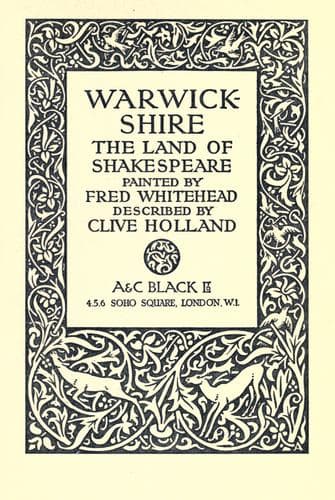
Warwickshire: The Land of ShakespeareHolland, Clive
History
Warwickshire: The Land of Shakespeare
Holland, Clive
Warwickshire (England) -- Description and travel
The street entrance is directly into the chief living room of the
house, which is stone paved, and provided with an old–fashioned
recessed fireplace, as is also the kitchen. Behind the latter are
two small apartments known as the wash–house and pantry. Beneath the
kitchen is a small cellar reached by a flight of steps, and probably
remaining much in its original state.
The principal room of the upper floor, facing the street, and reached
by an oak staircase of ten steps, is the birth–room. The walls,
ceiling, and windows are covered by numberless signatures, written
and scratched upon them by “pilgrims” before the custom was strictly
prohibited. Amongst this strange collection of autographs can still be
deciphered many of interest, including those of Izaak Walton, Thomas
Carlyle, Sir Walter Scott, and other famous people. The bureau in the
room was brought from the Old College, demolished in 1799, and the
chairs were gifts. This by no means imposing chamber not only witnessed
the birth of the poet, but in all likelihood those of his brothers
and sisters, and was the death–chamber of his father, mother, and
sister Susannah, Mrs. Hart. In a room at the back of this, originally
forming two small bedrooms, is an oil painting presumed to be that
of Shakespeare. It closely resembles the bust in the church, and was
possibly copied from it. It was given to the house by Mr. W. O. Hunt,
and is supposed to have originally belonged to the Clopton family,
having been found in Edward Clopton’s house on his death. Curiously
enough, the face was formerly disguised with a beard, which a Mr.
Collins, a connoisseur of some note, discovered was painted over the
original picture. The portrait was, therefore, cleaned and repaired
(the beard being removed in the process), and was afterwards deposited
at the birthplace. The sign–boards in the room are old ones belonging
to the house.
There is none of the original furniture in the house, it having long
ago been sold, broken up, or otherwise disposed of. In Shakespeare’s
day the furniture of a house of this size and type must have been of
a very simple character. It would have consisted of little beyond a
substantial table, a press, chairs, a cupboard, and a tall clock, with
the usual table utensils in the living room; and a four–post wooden
bedstead, a chair or two, and a table or washstand in the bedrooms. The
floors were carpetless, though those of the living room and kitchen
might be strewn with rushes.
The Museum occupies the portion of the building used by John
Shakespeare as a store and shop. It contains a large number of
Shakespearian and other relics, concerning the authenticity of some of
which there must be grave doubt. Amongst the most interesting in the
lower part of the Museum is the desk which Shakespeare is traditionally
supposed to have used when a lad at the Grammar School, from whence it
was removed to the Museum some years back.
Public-domain text, read in full here on John Shaqi.
Reviews
Reviews
No reviews yet
Be the first to share your thoughts on this work.
Elsewhere in the archive
Join the Discussion
Join the discussion
Sign in to leave a comment or review.
Sign InorCreate an account