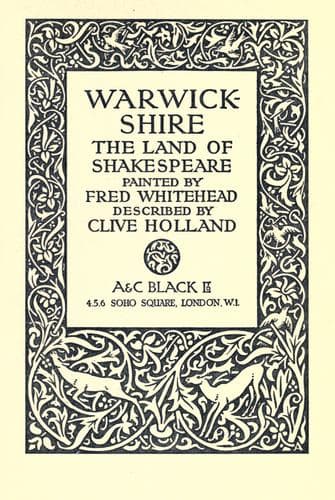
Warwickshire: The Land of ShakespeareHolland, Clive
History
Warwickshire: The Land of Shakespeare
Holland, Clive
Warwickshire (England) -- Description and travel
The Armoury passage, a narrow corridor running at the back of the gilt
drawing–room, State bedroom, and boudoir, and connecting the latter
and the compass room, contains one of the finest private collections
of medieval armour and weapons in England, as well as quite a number
of portraits by Van Dyck, Sir G. Hayter, and others of inferior merit.
Amongst the former is a portrait of Christ, said to be one of several
painted from a likeness engraved on an emerald presented to Pope
Innocent VIII. by the Grand Turk. Amongst the examples of armour are
battle–axes, crossbows, calivers, pikes, arquebuses, daggers, swords,
etc. of almost every period of the Middle Ages; and a fine and almost
unique suit of chain–mail, of which each link has its separate rivet.
The Compass Room is a small polygonal antechamber communicating with
the gilt room. The principal window contains painted Flemish glass
of considerable merit. In this room are some magnificent pictures,
including Murillo’s famous “Laughing Boy,” and a saint by the same
artist; a fine head of an old man by Rubens; a Bacchanalian Group, by
the same; a good portrait of Maximilian, the first Emperor of Germany,
and his sister, by Lucas Cranach; and the two scriptural pictures, St.
Paul Lighting a Fire (Isle of Melita), and St. Paul Shaking off the
Viper, both by Rubens.
The chapel has a beautiful window of old painted glass, given by the
Earl of Essex in the middle of the eighteenth century; and in the
west window is a headless statuette of a Palmer, thought to be a
representation of Guy, Earl of Warwick, in pilgrim’s garb.
In the Great Dining–Room, built by Francis, first Earl of Warwick,
about the year 1770, are hung some fine pictures, including the famous
equestrian portrait of Charles I. by Van Dyck.
The library, which was unhappily destroyed by the fire of 1871, was
restored from designs of Mr. G. Fox. The ceiling is panelled and
gilded, and there is some beautiful Italian work in the sides of the
doors, and a Venetian hooded–marble chimney–piece is of most graceful
design.
The Shakespeare room, originally a laundry, which adjoins Cæsar’s
Tower, contains, as its name implies, the unique collection of
Shakespearian memorials. There are good portraits of Queen Elizabeth;
Robert Earl of Leicester; John Locke the historian; Oliver Cromwell;
Sir Philip Sidney; and a Shakespeare supposed to be by Cornelis
Janssens. The room also contains a magnificent piece of furniture,
known as the Kenilworth Buffet, which was constructed out of an oak
tree formerly growing in the grounds of Kenilworth Castle. The central
panel depicts “Queen Elizabeth’s entry into Kenilworth Castle;” and the
other panels scenes from Sir Walter Scott’s novel _Kenilworth_, with
figures of Shakespeare, Sir Philip Sidney, Sir Walter Raleigh, and Sir
Francis Drake. The Buffet was presented to the Earl and Countess of
Warwick on their marriage.
Public-domain text, read in full here on John Shaqi.
Reviews
Reviews
No reviews yet
Be the first to share your thoughts on this work.
Join the Discussion
Join the discussion
Sign in to leave a comment or review.
Sign InorCreate an account