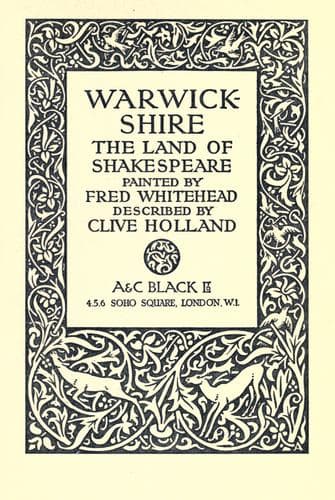
Warwickshire: The Land of ShakespeareHolland, Clive
History
Warwickshire: The Land of Shakespeare
Holland, Clive
Warwickshire (England) -- Description and travel
Amongst the treasures relating to Shakespeare are the only known MSS.
of his plays written before the close of the seventeenth century. The
first of these, which is supposed to have been written about the year
1610, is “The History of King Henry IV.,” the two parts in one, and
consists of fifty–six leaves. It is generally believed to be in the
handwriting of Sir Edward Dearing, of Surrenden, Kent, and to have been
transcribed by him from some other MS. since lost, as no printed copy
is extant containing the various corrections and alterations shown in
this MS.
There is also a volume of MS. poetical pieces, including a copy of
“Julius Cæsar,” transcribed in the reign of Charles II. This play, it
is clear from the enormous variations from all printed editions, must
have been transcribed from some independent version, and it seems more
than probable from an ancient playhouse copy.
In addition to these notable MSS. there are a fine copy of the folio
edition of 1623; a “Hamlet,” 1607, 1637, 1676; the second part of “King
Henry VI.,” 1619; “King Lear,” of 1608; “The Merchant of Venice,” of
1600; as well as a “Romeo and Juliet,” 1599; and a very interesting
collection of wardrobe and property bills of the Theatre Royal, Drury
Lane, dating from 1713 to 1716.
Of great interest outside the more domestic portion of the castle is
Cæsar’s Tower, in the dungeons of which so many persons during past
ages must have been confined, some of them doubtless never to be
released save to go to execution. The dungeon—on the walls of which are
rudely scratched inscriptions, drawings of bows and arrows, crucifixes,
and coats–of–arms—is a strong, stone–vaulted chamber 17 feet by 13 feet
and 14 feet 6 inches high. The roof is groined in two bays, and on the
south side is a plain semicircular opening, admitting a beam of light
from a deeply splayed window about 6 inches wide. On the same side of
the dungeon is a passage cut off from the prison by an iron grating, so
as to prevent access.
From the top of Guy’s Tower, which is reached by a staircase of one
hundred and thirty–three steps, there is a fine general view of the
castle itself, as well as the wide prospect of the surrounding country
A noticeable feature of the tower is the immense strength of the vault
beneath it, which would apparently point to the fact that in olden days
some heavy engine for the purpose of slinging stones must have been
placed upon the roof. In the tower there are five floors, each having
a groined roof, and subdivided into one large and two small rooms, the
sides of which in most cases are pierced with numerous loopholes for
bowmen commanding in all directions the curtains which the tower was
built to protect.
Public-domain text, read in full here on John Shaqi.
Reviews
Reviews
No reviews yet
Be the first to share your thoughts on this work.
Join the Discussion
Join the discussion
Sign in to leave a comment or review.
Sign InorCreate an account