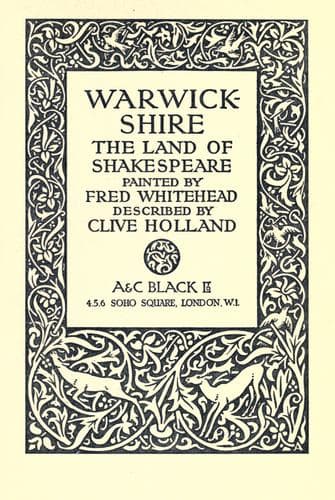
Warwickshire: The Land of ShakespeareHolland, Clive
History
Warwickshire: The Land of Shakespeare
Holland, Clive
Warwickshire (England) -- Description and travel
With the many tragedies and pageants which have in the dark ages of
the pre–Medieval period down to the golden age of Elizabeth taken place
within the enduring walls of this ancient stronghold, it is impossible
to deal here. But in this ancient feudal castle the student, artist,
and lover of the past will recognise one of the finest monuments
in England of ancient splendour which yet remains happily largely
uninjured by time. In it we have also an almost unique memorial of
that transition period when the more severe and forbidding features
of fortress–dwellings were being slowly replaced by others of a more
domestic if not the less imposing character.
[Illustration: UFTON.]
CHAPTER V
COVENTRY: ITS HISTORY, ROMANCE, CHURCHES, AND ANCIENT BUILDINGS
The ancient city of Coventry—situated amidst sylvan scenery of
great beauty, should if possible be approached by the wayfarer
from Kenilworth along the unrivalled avenue which is also the high
road—is of great antiquity and of very considerable interest to the
archæologist. Seen from a distance, on account of its many church
spires, it presents a wonderfully picturesque appearance; and with its
old–world survivals in the shape of timbered houses and the exquisite
architecture of its churches, is one of the most interesting towns of
the Midlands.
One derivation of the name is generally supposed to indicate that it
was originally Couentre; the first syllable representing a convent,
with the addition of the British affix “tre,” meaning a town. Other
authorities appear, however, to think that the name was derived from
Cune, the Celtic name of the River Sherbourne, on which the town
stands, and the affix “tre,” as already explained. At any rate the town
is of great antiquity, and is generally supposed to have been founded
by the Britons, although it is agreed that its history cannot be traced
with any great degree of accuracy prior to about 1016, when, according
to Rous the historian, Canute, King of Denmark, during his invasion of
Mercia amongst other ravages destroyed a nunnery, which at that period
had been founded at Coventry. The same authority further states that no
attempt was made to restore or rebuild this establishment until about
the middle of the same century, when Leofric, then Earl of Mercia, and
his Countess, the famous Godiva, founded a Benedictine monastery on
a site half a mile to the south of the original Saxon Nunnery of St.
Osburg.
It appears that Leofric not only bestowed upon the monastery half
of the entire town, but also gave to it in the reign of Edward the
Confessor no less than twenty–four other towns in the county of Warwick
and elsewhere. Leofric’s lady, Godiva, also enriched this foundation
with much treasure, searching throughout the country for “skilful
goldsmiths, who, with all the gold and silver she had, made crosses,
images of saints, and other curious ornaments, which she devoutly
disposed thereto.”
Public-domain text, read in full here on John Shaqi.
Reviews
Reviews
No reviews yet
Be the first to share your thoughts on this work.
Elsewhere in the archive
Join the Discussion
Join the discussion
Sign in to leave a comment or review.
Sign InorCreate an account