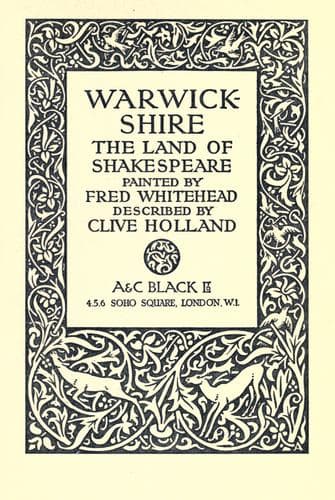
Warwickshire: The Land of ShakespeareHolland, Clive
History
Warwickshire: The Land of Shakespeare
Holland, Clive
Warwickshire (England) -- Description and travel
In 1610 King James I., in a letter addressed to the heads of the city
and the Church, commanded that the inhabitants should kneel whilst
receiving the sacrament, and when they several years later applied to
him for a renewal of their charter the King refused to grant it until
he had been satisfied that his command regarding their kneeling when
receiving of the sacrament had been obeyed. A few years later the King
visited Coventry and was presented with what must be almost considered
the inevitable £100, and in addition thereto with a silver cup of
fine workmanship weighing forty–five ounces, out of which, the King
exclaimed, that he would drink wherever he went.
During the succeeding reign and the Civil War which broke out,
Coventry attached itself to the side of Parliament; the influence of
Lord Brooke of Warwick overpowering that of the Earl of Northampton,
who was Recorder and a staunch Royalist. At the outset of the war,
King Charles, after he had raised his standard at Nottingham, sent to
Coventry and demanded quarters, and these being refused he attacked
the city in full force and succeeded in capturing one of the gates.
He was, however, finally repulsed with considerable loss, and obliged
to abandon his attempt to take the town. For this act of contumacy
and the fact that it was garrisoned by Parliamentary troops until
the Restoration it was destined to suffer later on. Charles II.,
notwithstanding the enthusiastic demonstrations of the inhabitants
at his restoration and the surrender of possessions which the city
had originally purchased from the Crown, did not forget the part
Coventry had played during the Civil War, and a commission held in 1662
prescribed the demolition of the city walls as a mark of the King’s
displeasure for the disloyalty of the inhabitants to his father. This
act was immediately put into effect by the Earl of Northampton. All
that now remains of the fortifications are two of the gates, Cook
Street Gate, now a mere roofless shell, and the Swanswell or Priory
Gate in Hales Street, which after the archway had been blocked up some
years ago was converted into dwellings.
Twenty–five years later, when King James II. visited Coventry, the
citizens, no doubt remembering the exactions and punishment under which
they suffered in the previous reign for their old–time disloyalty to
the Crown, paid the King the greatest marks of attention and respect.
They presented him with a gold cup and cover, and even went the
length of smoothing the rough surfaces of their streets with sand,
white–washing their houses, and decorating them with garlands and
flags. Occasionally interesting relics of the Roman occupation are
discovered when excavating foundations for new buildings, and when
laying out new roads.
Public-domain text, read in full here on John Shaqi.
Reviews
Reviews
No reviews yet
Be the first to share your thoughts on this work.
Elsewhere in the archive
Join the Discussion
Join the discussion
Sign in to leave a comment or review.
Sign InorCreate an account