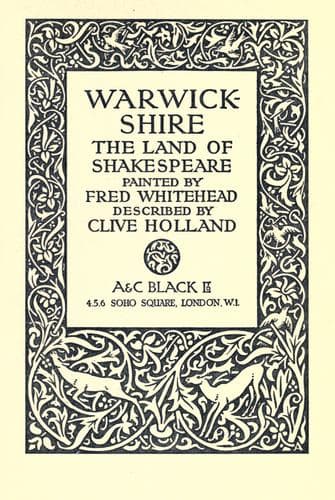
Warwickshire: The Land of ShakespeareHolland, Clive
History
Warwickshire: The Land of Shakespeare
Holland, Clive
Warwickshire (England) -- Description and travel
The glamour of Kenilworth is undeniable, and doubtless has been not a
little added to from the fact that so great and vivid a descriptive
writer as Sir Walter Scott made it the _locale_ of one of his most
popular and perhaps most readable novels. That his history is not
entirely accurate has little or nothing to do with the enjoyment of the
book by the general reader, nor does it militate against the interest
aroused in the fine ruins of the castle which he made the scene of so
much pageantry and romance.
The name of Kenilworth is probably derived from the Saxon owner
Kenulph or Kenelm, and “worthe,” signifying a dwelling–place; but in
the Domesday Book it is called Chenewrd, and in some Charters Chenille
Wurda, the “worthe” or manor of Chenil. Whether the original owner of
the manor was one named Chenil, or Kenelm the Mercian, there is no
satisfactory evidence, but Dugdale associates the name with the latter,
and this, indeed, seems the more probable derivation. One thing appears
certain, however, namely, that the original founder of Kenilworth
was a man of considerable position, because his buhr or keep and its
earthworks were both extensive and strong.
[Illustration: BADDESLEY CLINTON HALL.]
At the period of the Domesday Book the manor of Kenilworth was a
portion of the royal manor of Stoneleigh, and was divided into two
parts, known as “Opton or Upton, containing three hides, held direct
of the King by Albertus Clericus, in pure alms; and Chineworde, held
by Ricardus Forestarius. Opton is upper–town or high–town, the rising
ground to the north of the present church. Chineworth is Kenilworth
proper.” It seems probable that Chineworth is a corruption of the name
Kenilworth.
The ancient history of the castle is, owing to the great alterations
made by succeeding owners and the absence of records, very difficult to
trace, though it is quite certain that the owner of the manor during
Saxon times, as was usual, fortified the best position by earthworks,
and also probably erected an earthen keep. The exact site of the
latter is quite an open question, as is the point as to which of the
earthworks now traceable date back to the far remote period of Saxon
times. Indeed, until the reign of Henry I. the history of the castle is
largely speculative. Some authorities incline to the view that the site
of the present buildings was in Roman times that of a fort, temporary
or otherwise; which the Saxon chief afterwards selected, adopted, and
enlarged, that it might afford shelter and security for his own flocks
and herds which roamed the Arden, and even those also of his immediate
dependants.
Kenilworth and its several owners during the Middle Ages saw many
vicissitudes and several tragic events. In the Barons’ War it changed
hands several times, and among its most famous owners was Simon de
Montfort, Earl of Leicester, who led the Barons against King Henry III.
Public-domain text, read in full here on John Shaqi.
Reviews
Reviews
No reviews yet
Be the first to share your thoughts on this work.
Elsewhere in the archive
Join the Discussion
Join the discussion
Sign in to leave a comment or review.
Sign InorCreate an account