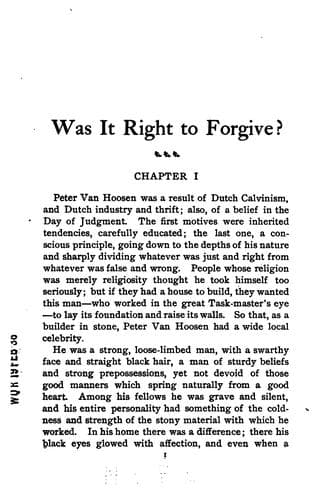
Was It Right to Forgive? A Domestic RomanceBarr, Amelia E.
General
Was It Right to Forgive? A Domestic Romance
Barr, Amelia E.
Fiction
"I care nothing about her rudeness to me. It is her treatment of
Antony I resent. I shall not countenance her in any way until she
confesses her sin to her husband, and he forgives her. If Antony can
forgive her, I suppose I may try and endure her."
"Dear cousin----"
"Nonsense, Yanna! You know me well enough to understand that having
made up my mind on this subject, I shall not unmake it for any other
terms but the ones I have accepted as reasonable and right.
Confession, my dear, and then forgiveness. Everything must be done in
its proper order. Do you not find me in a remarkably happy temper? Do
you not want to know the reason? Harry has been here this morning, and
he has told me a very wonderful story. I don't know when I have been
so pleased. I have been saying to myself ever since that there is no
change in Our Redeemer. The world outgrows its creeds, but it is still
blessedly true that they who 'seek for Him with all their heart find
Him.' My dear, I feel to-day that there is a God. I always know it,
but to-day I feel it. That is the reason I am so happy. I like that
woman Hannah Young. I am going this day to the Salvation Army
Headquarters to find her. The devil gave her the means to make her
mother and sisters happy; and I intend to show her that God can do
more, and better, than the devil."
"Have you no pity for Rose?"
"Not for Rose proud and wicked and unrepentant. When Rose is sorry for
her sins, when God forgives her, I shall have no right to be angry.
And what do you ask me to do? The worst possible thing for a woman
like Rose--surround her with circumstances that enable her to forget
what she ought not to forget for one moment. I--will--not--do--it!"
This disappointment did not, however, deter Mrs. Filmer from carrying
out her plan; and invitations were duly sent to such of Rose's old
friends as it was supposed would give prestige and dignity to the
occasion of her first dinner. Miss Alida sent a curt refusal; and all
of the people whose presence was most desired did likewise, with
varying politeness. Some "regretted very much," and others simply
"regretted." Some had "previous engagements," others did not lay this
flattering excuse to the wound of their declining; but the fine
dinner was, after all, prepared for guests who had been asked as
"secondaries," and whose absence would not have been regretted. In
some way--probably through the kitchen door--the true story of
Antony's absence had been blown about by every wind of gossip; and
Rose's dinners, however she might regard them, were not important
affairs to a class of people to whom dinners meant lofty and
irreproachable social intercourse.
Public-domain text, read in full here on John Shaqi.
Reviews
Reviews
No reviews yet
Be the first to share your thoughts on this work.
Elsewhere in the archive
Join the Discussion
Join the discussion
Sign in to leave a comment or review.
Sign InorCreate an account