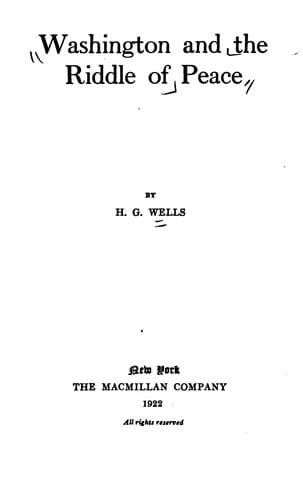
Washington and the Riddle of PeaceWells, H. G. (Herbert George)
History
Washington and the Riddle of Peace
Wells, H. G. (Herbert George)
Conference on the Limitation of Armament (1921-1922 : Washington, D.C.); Peace; World politics
However, I am an obstinate believer in the common sense and good will of
the American people, and I do not believe that a press campaign,
designed to make a great people behave after the fashion of some
hysterical back-street Oriental usurer who has struck a bad debt, is
likely to do anything but recoil severely on the heads of those who have
set it going. And I am not a believer in that sort of “tact” which would
avoid reminding the American public of the circumstances under which
these war debts were incurred.
The Russian debt to France was spent largely upon war and war
preparations while Russia was the ally and helper of France; the war
debts of the European Allies to Britain and America and the British debt
to America were spent upon war material. All these debts are for efforts
spent upon a common cause. Each country spent according to its
resources, as good allies should. Russia gave life and blood—and blood.
She gave 4,000,000 men; she smashed up her own social fabric. France and
Britain gave the lives of men beyond the million mark. Also they gave
much material, an enormous industrial effort. So also did Italy,
according to her power.
The British developed a vast production of munitions as the war went on,
using great supplies of material from America, for which they paid high
prices and on which great profits were made in America. At last America
joined the war, with her enormous reserves and strength, and gave not
only great stores of material but the lives of between 50,000 and 75,000
men. And so, altogether, America and the Allied Powers, giving their
lives and substance as they could, saved civilization from imperialism.
The British do not grudge the contribution they have made and all that
they have still to contribute for their share in that colossal victory,
but some of us English here are growing a little irritated at being
dunned as defaulters when we are not going to default, and at having our
attempts to work in co-operation with the Americans for the
rehabilitation of a strained and collapsing civilization explained as
the interested approaches of a cadging poor relation.
I wish that Americans would think of the Europeans more frequently as
people like themselves. The boys who came to Europe saw the European
armies in ranks like their own, good stuff and kindred stuff. They were
their comrades in arms; they fought and died beside them. They saw
countries and a common life very like the American country life; they
discovered that the French and British and Italians were also “just
folk.”
Public-domain text, read in full here on John Shaqi.
Reviews
Reviews
No reviews yet
Be the first to share your thoughts on this work.
Elsewhere in the archive
Join the Discussion
Join the discussion
Sign in to leave a comment or review.
Sign InorCreate an account