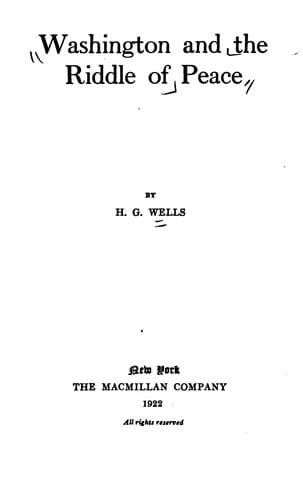
Washington and the Riddle of PeaceWells, H. G. (Herbert George)
History
Washington and the Riddle of Peace
Wells, H. G. (Herbert George)
Conference on the Limitation of Armament (1921-1922 : Washington, D.C.); Peace; World politics
If she desires isolation, moral exaltation, irresponsibility and
self-sufficiency, “America for the Americans and never mind the
consequences,” she must be prepared to witness the decline and fall of
the white civilization in Europe and the consolidation of a profoundly
alien system across the Pacific. If, on the other hand, she now takes up
this task for which she seems so inclined, as the leader and helper of
white civilization, the task of organizing the permanent peace of the
world upon the lines of the system of civilization to which she belongs,
then for that nobler role also there is a price to be paid. She has to
assume not only the dignity but the responsibilities of leadership. She
has not merely to express noble sentiments, but to lay hold upon the
difficulties and intricacies of the problem before her. She has not
merely to criticise but to consider and sympathize and help, and she has
to make decisions and abide by them.
When America really makes decisions, she abides by them—vigorously. The
Monroe Doctrine was such a decision. It has saved South America for
South Americans; it has saved Europe from a ruinous scramble for the
Spanish inheritance. It was the first great feat of Americanism in world
politics. The exponents of “Tact” will, I know, be outraged by the
reminder that for a long time tacit approval of Britain and the
existence of the British fleet provided a support and shield to the
Monroe Doctrine, and also by the further reminder that the one serious
attack upon it was made by Napoleon III. during the American Civil
War—at which time, I admit, the attitude of Great Britain to the
disunited States was also far from impeccable. But helped or assailed,
the Monroe Doctrine held good.
The Washington Conference has developed a position with regard to the
Pacific that calls for an American decision of equal vigor. It is as
plain as daylight that Japanese liberal tendencies can be supported and
the aggressive ambitions of Japanese imperialism can be restrained, that
China can be saved for the Chinese and Eastern Siberia from foreign
conquest, provided America places herself unequivocally side by side
with Great Britain and France in framing and _sustaining_ a definite
system of guarantees and prohibitions in Eastern Asia. The
Anglo-Japanese agreement could be ended in favor of such a new
peace-pact and an enormous step forward toward world peace be made. It
would mark an epoch in world statecraft.
Public-domain text, read in full here on John Shaqi.
Reviews
Reviews
No reviews yet
Be the first to share your thoughts on this work.
Elsewhere in the archive
Join the Discussion
Join the discussion
Sign in to leave a comment or review.
Sign InorCreate an account