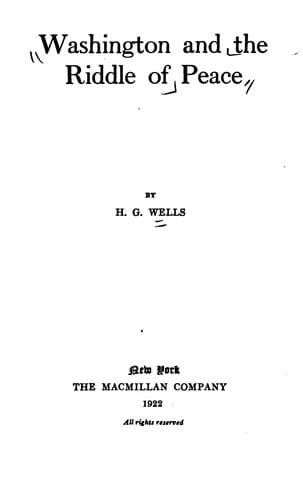
Washington and the Riddle of PeaceWells, H. G. (Herbert George)
History
Washington and the Riddle of Peace
Wells, H. G. (Herbert George)
Conference on the Limitation of Armament (1921-1922 : Washington, D.C.); Peace; World politics
Still, apart from the fact that the British will always refuse to fight
America, there does seem to be no real reason why, in the absence of a
developing peace alliance to prevent it, either of the other two matches
I have cited should not be played. In the long run, you cannot avoid
fighting if you avoid comprehensive alliances and standing arrangements
for the settlement of differences with the people you may otherwise
fight.
So let us try and imagine a war between a pair of these four powers,
five or ten years ahead. They have avoided any entangling alliances, or
agreements, or settlements, kept their freedom of action and are
thoroughly—_prepared_.
Let us not fall into the trap of supposing that these wars will follow
the lines of the Great War of 1914–18 and that we shall have a rapid
line-up of great entrenched armies, with massed parks of artillery
behind them, tank attacks and all the rest of it. That sort of war is
already out of fashion, and the fact that these wars that we are
considering will be overseas wars puts any possibility of such a dead
lock of land armies out of the case. The combatants will have to set
about getting at each other in quite other fashions.
Let us recall the maxim that the object of all fighting is to produce a
state of mind in the adversary, a state of mind conducive to a
discontinuance of the struggle and to submission and acquiescence to the
will of the victor. Old-time wars aimed simply at the small antagonist
army and at the antagonist Government, but in these democratic days the
will for peace or war has descended among the people and diffused itself
among them, and it is the state of mind of the whole enemy population
that has become the objective in war. The old idea of an invading army
marching on a capital, gives place, therefore, to a new conception of an
attack through propaganda, through operations designed to produce acute
economic distress, and through the air, upon the enemy population.
Public-domain text, read in full here on John Shaqi.
Reviews
Reviews
No reviews yet
Be the first to share your thoughts on this work.
Elsewhere in the archive
Join the Discussion
Join the discussion
Sign in to leave a comment or review.
Sign InorCreate an account