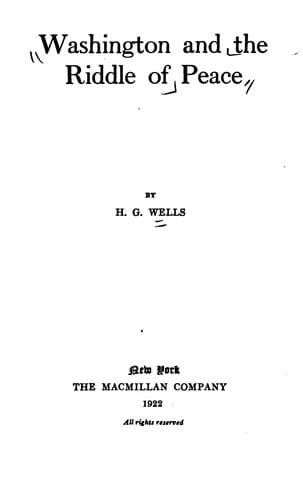
Washington and the Riddle of PeaceWells, H. G. (Herbert George)
History
Washington and the Riddle of Peace
Wells, H. G. (Herbert George)
Conference on the Limitation of Armament (1921-1922 : Washington, D.C.); Peace; World politics
But the mention of China brings us back to the possibility of applying
the precedent of China to India. The discussions and perplexities of the
last two or three years which have culminated in the Washington
Conference have slowly worked out and made clear the possibility of a
new method in Asia. This is the method of concerted abstinence and
withdrawal, the idea of a binding agreement of all the nations
interested in China and tempted to make aggressions upon China to come
out of and to keep out of that country while it consolidated itself and
develops upon its own lines.
This new method, which has had its first trial at the Washington
Conference, is a complete reversal of the method of dealing with
politically confused or impotent countries and regions adopted at
Versailles. It is an altogether more civilized and more hopeful method.
Versailles and the League of Nations were ridden by the idea of
mandates. All over the world where disorder or weakness reigned a single
mandatory power was to go in, making vague promises of good behavior, to
rule and exploit that country. It was the thinnest, cheapest camouflage
for annexation; it was a hopeless attempt to continue the worst
territory-seizing traditions of the nineteenth century while seeming to
abandon them. It was Pecksniff imperialism. So we had the snatching of
Syria, of Mesopotamia, and so forth. But any soundly constituted League
or Association of Nations should render that sort of thing unnecessary
and inexcusable.
The reason lying at the base of the British occupation of India, of the
Japanese occupation of Corea, of the French in Indo-China, and so forth,
is a perfectly sound reason so long as there is no Association of
Nations, and it is an entirely worthless one when there is such an
association—it is that some other power may otherwise come into the
occupied and dominated country and use it for purposes of offense. The
case of the British in India, that they have kept an imperial peace for
all the peoples of that land, that they warded off the Afghan raiders
who devastated India in the early eighteenth century and afterward the
long arm of Russia, is a very good one indeed. The British have little
cause to be ashamed of their past in India and many things to be proud
of. But they have very good cause, indeed, for being ashamed of their
disregard of any Indian future. They have sat tight and turned peace
into paralysis. They have not educated enough or released enough. Always
the excuse for suppression has been that fear of the rival.
Well, the whole purpose of an Association of Nations is to eliminate
that fear of a rival and all that that fear entails in war
possibilities.
Public-domain text, read in full here on John Shaqi.
Reviews
Reviews
No reviews yet
Be the first to share your thoughts on this work.
Elsewhere in the archive
Join the Discussion
Join the discussion
Sign in to leave a comment or review.
Sign InorCreate an account