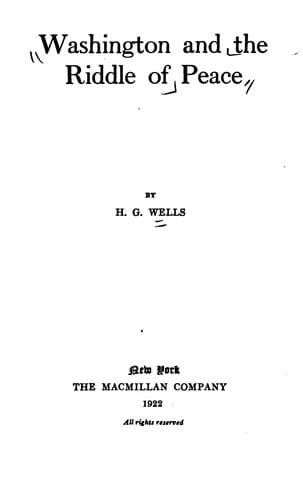
Washington and the Riddle of PeaceWells, H. G. (Herbert George)
History
Washington and the Riddle of Peace
Wells, H. G. (Herbert George)
Conference on the Limitation of Armament (1921-1922 : Washington, D.C.); Peace; World politics
He read his address in that effective voice of his which seems to get
everywhere without an effort. I listened attentively to every sentence
of it, although I knew that upstairs there would be a printed copy of it
for me as soon as the delivery was over. Yet, although I was listening
closely, I also found I was thinking a great deal about this most potent
gathering, for potent it is, which has been raised up now to a position
of quite cardinal importance in human affairs.
President Harding is on what are nowadays for a President exceptionally
good terms with Congress. He means to keep so. In his address he
reiterated his point that even the full constitutional powers of the
President are too great and that he has no intention to use them, much
less to strain them. Nevertheless, or even in consequence of that, he is
very manifestly the leader of his Legislature. The atmosphere was
non-contentious. He was not like a party leader speaking to his
supporters and the opposition. He was much more like America
soliloquizing. His address was a statement of intentions.
I think the President feels that officially he is not so much the elect
of America as the voice of America, and instead of wanting to make that
voice say characteristic and epoch-making things, he tries to get as
close as he can to the national thought and will. What President Harding
says today America will do tomorrow. One human and amusing thing he
did—he was careful to drag in that much-disputed word of his,
“normalcy,” which he has resolved, apparently, shall oust out
“normality” from current English.
And from the point of view of those who are concerned about the dark
troubles of the world outside America it was, I think, a very hopeful
address. It reinforced the impression I had already received of
President Harding as of a man feeling his way carefully but steadily
towards great ends. America’s growing recognition of her “inescapable
relationship to world finance and trade” came early and his little
lecture on the need to give and take in foreign trade was a lecture that
is being repeated in every main street in America.
He spoke of Russia and returned to that topic. “We do not forget the
tradition of Russian friendship” was a good sentence that some countries
in Europe may well mark. The growing belief in America of the
possibility of going into Russia through the agency of the American
Relief Administration and of getting to dealing with the revived
co-operative organizations of Russia is very notable. And though there
was no mention of the Association of Nations as such, there were
allusions to the “world hope centered upon this capital city” and to the
universal desire for permanent peace.
Public-domain text, read in full here on John Shaqi.
Reviews
Reviews
No reviews yet
Be the first to share your thoughts on this work.
Elsewhere in the archive
Join the Discussion
Join the discussion
Sign in to leave a comment or review.
Sign InorCreate an account