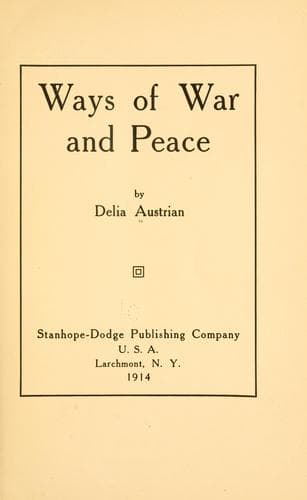
Peace; World War, 1914-1918 -- Personal narratives
He has a thorough knowledge of engineering and electricity, paints
pictures, plays chess, and he does all this with the use of his one
hand. He feels that all these things are his avocations, an outlet for
his energy. With his great talent for organization, he realized that a
country to be prosperous needs factories and plenty of trade schools. He
was absorbed in the trade and commercial schools along with the school
of forestry, which have had an international and enviable reputation,
and which has made Germany one of the great industrial powers of modern
times. He gave every incentive to have his men stay at home in
encouraging all kinds of factories, lake, and water ways, the building
of canals, ocean liners and merchant marine. For it was the increasing
of the numbers of ocean liners and merchant marine that made German
merchandise popular and well-known in most of the ports of the world.
He has kept abreast of the times regarding the manufactures in England
and the United States. He has always taken an active interest in the
machinery and electrical contrivances used in American factories and in
the home.
Every year he sent many men to this country to study the methods
employed in our shoe factories, tanneries, cotton mills, our electrical
appliances and telephone services. As a result many of the German
factories have the best of American machinery, American mechanics at the
head, and they have worked out their telephone service, typewriters,
adding machines and cash registers after our designs. Though the Emperor
spent much of his time enlarging the army and navy, he considered these
as a safeguard to his country, but it is the commercial interests of
Germany he has at heart most.
He loved to read about the Panama Canal and to hear people discuss it,
for he recognized it as the great engineering feat of the century. He
would rather had it said that Germany had built the Panama Canal than
that she had organized the largest and strongest army in Europe. So
eager was he to know all these things that he mastered six languages
fluently. He began his day's work at seven and continued it until five,
with a short interval for his noonday meal and afternoon drive. Though
he often had a few intimate friends to supper, his evenings usually
finished with work which lapsed way into midnight.
Though the Emperor is often blamed as having precipitated the war, the
point is overlooked that Servia, backed by Russia, was trying her utmost
to disintegrate Austria. When Austria made war on Servia without
consulting Germany, it was the war party in Germany that held it was up
to Germany to help her ally. The Emperor of Germany was lukewarm in this
matter. He felt that the war should be confined to Austria and Servia.
He was surprised and grief-stricken when he returned to Berlin and
learned what had happened. It was only after he learned that England and
France were backing Russia that he considered the war justifiable.
Public-domain text, read in full here on John Shaqi.
Reviews
Reviews
No reviews yet
Be the first to share your thoughts on this work.
Elsewhere in the archive
Join the Discussion
Join the discussion
Sign in to leave a comment or review.
Sign InorCreate an account