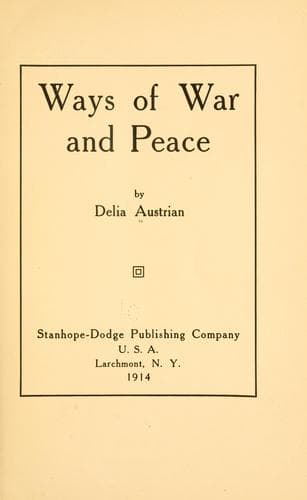
Peace; World War, 1914-1918 -- Personal narratives
The people in Russia do not object to the cold, uninviting houses.
Pleasant days bring thousands into the streets below. The Nevsky
Prospect is a splendid street that intersects all the rings of the city.
It winds its way between the handsome residences, pierces the Chamber of
Commerce and touches the poorest parts of the city. Here all types of
Russian life are seen, from the proudest nobility, driving in their
auto-cars and handsome carriages, to the poorest peasants living in one
of those immense, densely crowded apartment buildings. The scene in this
portion of the street at about midday may challenge comparison with any
street in the world, and the spectacle is enhanced by the magnificence
of the decorations. Besides the handsome residences, there are many
large shops and cafés offering recreation to the crowds promenading up
and down.
St. Petersburg has a number of large summer gardens, which are an
adornment to the city and offer a pleasant rest to thousands in warm
weather. The Summer Garden is the largest and most attractive of these.
Everywhere are the large, well-shaded benches, thronged with matrons,
while the children play in the sand and catch their balls. On one side
of the Summer Garden is the Tzariziuski Lug, or Field of Mars. Now these
resorts are well nigh destitute of men.
There are a number of buildings in St. Petersburg that are worth
noticing. Of these the Exchange is certainly the most prominent. It
stands on the farthest point of Vassili Ostroff, with a large open space
before it, and it is reared on an elevated foundation. The granite quays
on either side give solidity, while a long flight of granite steps leads
down to the river. The space before the building is decorated with two
immense columns, supporting the prows of ships cast in metal and erected
to the memory of Mercury. The building is of immense proportions and
took twelve years to build. The great hall is lighted from above, while
at either end and on both sides are spaces in the forms of arcades.
There is an altar at one end, and a light is always kept burning for the
pious merchants, who offer up a prayer before they commence the
undertakings of the day.
The Hermitage Museum is a veritable treasure prison; there is a large
picture gallery, one of the finest and most celebrated in Europe. The
collection includes a large number of Dutch cottages, such as Van de
Meer and Ostada painted.
The gallery is equally rich in the old Italian and French masters. A
most interesting part of the collection are the treasures that were once
housed at Malmaison. When the Emperor Alexander was in Paris, he visited
the divorced consort of Napoleon, who spoke of the property that
remained to her and the insecurity of the possession. To protect it
until it could be reclaimed, Emperor Alexander bought the treasure and
took it to Russia.
Public-domain text, read in full here on John Shaqi.
Reviews
Reviews
No reviews yet
Be the first to share your thoughts on this work.
Elsewhere in the archive
Join the Discussion
Join the discussion
Sign in to leave a comment or review.
Sign InorCreate an account