Impressions of splendor depend very much upon contrast, so that
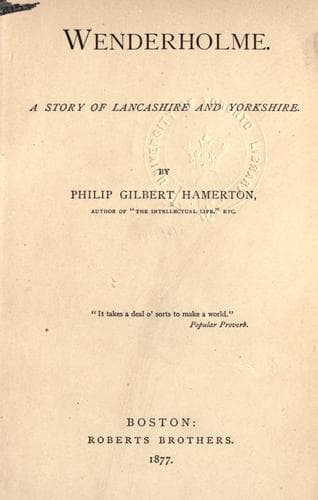
Wenderholme seemed very astonishing to a person coming directly from
Milend. But such impressions are soon obliterated by habit, and in a
week Mrs. Ogden will have lost the "fresh eye," to which she owes her
present sense of enchantment. How long would it take to get accustomed
to Blenheim, or Castle Howard, or Compiègne? Would it take a fortnight?
However, Mrs. Ogden had the advantage of a far fresher eye than _nous
autres_, who are so accustomed to gilding and glitter in public _cafés_
and picture-galleries, that we are all, as it were, princes, insensible
to impressions of splendor.
All that Mrs. Ogden said upon that memorable day it would be tedious to
relate. She thought aloud, and the burden of her thoughts, their
ever-recurring refrain, was her sense of the grandeur that surrounded
her. Jacob Ogden had bought a good deal of Colonel Stanburne's fine old
silver plate, and this formed the main subject of Mrs. Ogden's
conversation during dinner. "I think our Jacob's gone fair mad with
pride," she said to all the company, and in the hearing of the attentive
servants, "for we'd plenty of silver at Milend--quite plenty for any
one; we've all my uncle Adam's silver spoons, and my aunt Alice's, and
plenty of silver candlesticks, and a tea-service--and I cannot tell what
our Jacob would be at." Then she added, with serene complacency,
"However, it's all paid for."
She had not the art of avoiding a topic likely to be disagreeable either
to herself or anybody else, but would make other folks uncomfortable,
and torture her own mind by dwelling upon their sores and her own. I
don't think that in this she was altogether wrong, or that the most
delicate people are altogether right in doing exactly the contrary, for
it is as well to grasp nettles with a certain hardihood; but she carried
a respectable sort of courage to a very unnecessary excess. Thus, when
she had done about the silver and the general extravagance of "our
Jacob," the next topic she found to talk about was the absence of Mr.
and Mrs. Prigley. She launched forth into a catalogue of all the
benefits wherewith she had overwhelmed Mrs. Prigley in the days of her
poverty at Shayton, and represented that lady as a monster of
ingratitude. "Why, they were so poor," Mrs. Ogden said, "that they
couldn't even afford carpets to their floors; but now that they're
better off in the world, they turn their backs on those that helped
them. We were always helping them, and making them presents." Every one
saw that the Ogdens were dreadfully sore about the absence of the vicar
and his wife, and it was not very good policy on Mrs. Ogden's part to
draw attention to it in that way; for a parson, though ornamental, is
not absolutely indispensable to a good dinner, and they might have got
on very well without one.
Public-domain text, read in full here on John Shaqi.
Reviews
Reviews
No reviews yet
Be the first to share your thoughts on this work.
Elsewhere in the archive
Join the Discussion
Join the discussion
Sign in to leave a comment or review.
Sign InorCreate an account