Here are two points admitted, and the Journal mentioned should be
good authority upon which to rest them. First, the lack of positive
evidence, from which the necessary inference is that we must fall back
upon probability or conjecture, as the basis of our judgment in the
case. Second, that, as a general rule, churches were formed at the time
settlements were begun, or soon after. Without question the latter
statement is correct. The well known character and habits of the early
emigrants, and the facts that have come to us in connection with them,
prove this beyond a doubt. If, then, it can be proved that Weymouth
was a prosperous settlement at a much earlier date than that assumed
for it, 1635, we shall go far to prove the probability, at least, of
an earlier church organization. And this brings us to the subject of
the present paper, namely, What are our facts relative to the early
settlement of the town, and how do they concern the church and its
ministers?
The very general assumption that there was no permanent settlement in
Weymouth, (using the name by which the town has since been known),
previous to the arrival of the Hull company, in 1635, can hardly
be sustained in face of the very strong evidence to the contrary.
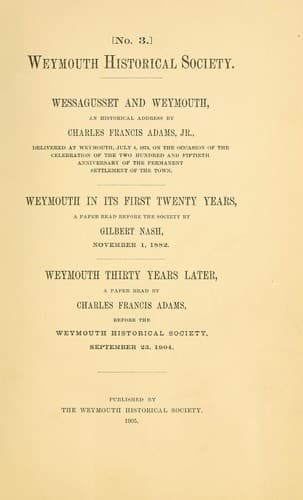
C. F. Adams, Jr., Esq., in his address delivered 4 July, 1874, at
the celebration of the two hundred and fiftieth anniversary of the
settlement of the town, and in his paper on the “Old Planters about
Boston Harbor,” read before the Massachusetts Historical Society, and
published in its collections, “the ablest paper,” says Rev. George E.
Ellis, D. D., no mean judge of such matters, “ever read before that
Society,” proves conclusively that the Gorges company, which settled
upon the deserted plantations of Thomas Weston’s people, in September,
1623, and which, it has been usually thought, was wholly broken up
in the following spring, left a number of its emigrants there, who
remained and became permanent settlers. These were joined from time to
time by single families or small companies, until, upon the arrival of
Mr. Hull’s company, the settlement had attained to quite respectable
proportions.
This ground has been so carefully covered by Mr. Adams in the papers
before mentioned, that it will be necessary only to mention very
briefly the main facts, and to sustain them by such other evidence as
may be had from the court and town records, as well as from private
sources.
Public-domain text, read in full here on John Shaqi.
Reviews
Reviews
No reviews yet
Be the first to share your thoughts on this work.
Elsewhere in the archive
Join the Discussion
Join the discussion
Sign in to leave a comment or review.
Sign InorCreate an account