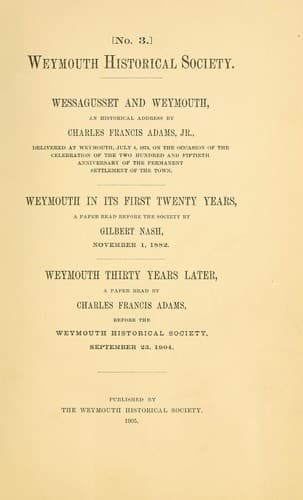
For a first performance, I will honestly confess it does not seem to
me, as I now look over it, wholly devoid of merit. Curiously enough
also, the best portions of it are distinctly the closing portions, in
which I wrote with a warmth and feeling absent from the earlier part.
Nevertheless, that Weymouth address of 1874, as I now see it, was, as
a whole, wrong in conception and faulty in execution. It was wrong in
conception, because in it I tried to cover too much ground. That it
was defective in execution, is most apparent. Accepting an invitation
to deliver a commemorative address on the 250th anniversary of the
permanent settlement of Weymouth, I attempted an historical sketch
covering the town’s whole existence. I ought to have confined myself
to a close analysis of its first twenty years. That period would have
opened to me, had I known how to use it, a field of investigation at
once ample in extent and curiously rich. Nor is this all; it would have
done a great deal more. Unwittingly, I missed the opportunity of a
life-time. Simply, I was not equal to the occasion. My consolation is
that few would have been equal to it. But of this, more presently.
To make either a comprehensive or careful analysis of the early history
of your town now, is out of my power; nor would one evening’s time
admit of it. I will, however, say that to-day, not less than in the
days of the late James Savage, “a careful history of Weymouth is much
wanted.”[100] Nine years after my prentice effort, your associate and
recording secretary, Gilbert Nash, approached the subject both with a
better comprehension, and a knowledge much closer and far wider than
I could boast. But my effort, supplemented though it was by him, left
much to be desired,--a desideratum it should be the mission of this
Society to make good.
Turning then to Wessagusset, and the early history of Weymouth, and
confining myself to them, I find its record composed of two parts:--the
Wessagusset settlements, pre-historic almost in character, and the
subsequent struggling into life of Weymouth, in the early years of the
colony. The story of Wessagusset is in itself curiously interesting,
as well as of momentous importance; and it was in connection with that
I missed the opportunity of a life-time, to which I just referred. It
vexes me now to think of it. It even brings to mind Whittier’s familiar
lines:
“For of all sad words of tongue or pen,
The saddest are these: ‘It might have been!’”
Public-domain text, read in full here on John Shaqi.
Reviews
Reviews
No reviews yet
Be the first to share your thoughts on this work.
Elsewhere in the archive
Join the Discussion
Join the discussion
Sign in to leave a comment or review.
Sign InorCreate an account