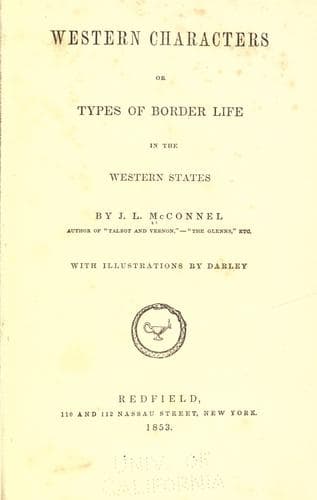
Western Characters; or, Types of Border Life in the Western StatesMcConnel, John Ludlum
General
Western Characters; or, Types of Border Life in the Western States
McConnel, John Ludlum
Frontier and pioneer life -- Mississippi River Valley; Mississippi River Valley -- Social life and customs
As the government waxed stronger, and public opinion assumed a
direction, the regulators, like their predecessors, the rangers, found
their "occupation gone," and gradually faded out from the land.
Proclamations were issued--legislatures met--laws were enacted, and
officers appointed to execute them; and though forcing a legal system
upon a people who had so long been "a law unto themselves," was a slow
and difficult process, it was powerfully assisted by the very disorders
consequent upon their attempts at self-government. They had burnt their
hands by seizing the hot iron-rod of irregular authority, and were,
therefore, better inclined to surrender the baton to those who could
handle it. Like Frankenstein, they had created a power which they could
not immediately control: the regulators, from being their servants, had
come to be their masters: and they willingly admitted any authority
which promised deliverance. They had risen in wrath, and chastised, with
no hesitating hand, the violators of their peace; but the reaction had
taken place, and they were now content to be governed by whatsoever
ruler Providence might send them.
The state governments were established, then, without difficulty, and
the officers of the new law pervaded every settlement. The character
which I have selected as the best representative of this period, is one
of these new officers--_the early justice of the peace_.
So far as history or tradition informs us, there was never yet a country
in which appointments to office were invariably made with reference only
to qualification, and though the west is an exception to more than one
general rule, in this respect we must set it down in the common
category. The lawyer-period had not yet arrived; and, probably, there
was never an equal number of people in any civilized country, of whom a
larger proportion were totally ignorant of legal forms. There were not
three in each hundred who had ever seen the inside of a courthouse, and
they were quite as few who had once looked upon a law-book! Where such
was the case, some principle of appointment was of course necessary,
other than that which required fitness, by training, for the office
conferred; and it is probable that the rule adopted was but little
different to that in force among those who have the appointing power,
where no such circumstances restrict the choice.
Men were appointed conservators of the _peace_, because they had
distinguished themselves in _war_; and he who had assumed the powers of
the law, as a regulator, was thought the better qualified to exercise
them, as a legal officer! Courage and capacity, as an Indian-fighter,
gave one the prominence requisite to his appointment; and zeal for the
preservation of order, exhibited as a self-constituted judge and
executioner, was a guaranty for the faithful performance of new and
regular duties.
Public-domain text, read in full here on John Shaqi.
Reviews
Reviews
No reviews yet
Be the first to share your thoughts on this work.
Elsewhere in the archive
Join the Discussion
Join the discussion
Sign in to leave a comment or review.
Sign InorCreate an account