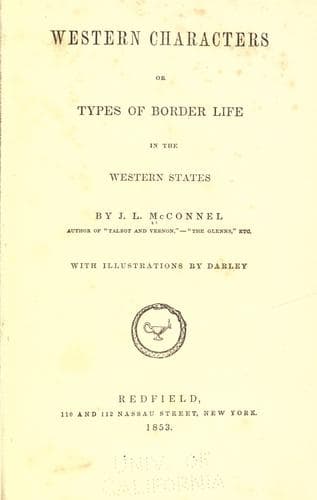
Western Characters; or, Types of Border Life in the Western StatesMcConnel, John Ludlum
General
Western Characters; or, Types of Border Life in the Western States
McConnel, John Ludlum
Frontier and pioneer life -- Mississippi River Valley; Mississippi River Valley -- Social life and customs
In those days, housekeeping was a very simple matter. Neither
steam-engines nor patent cook-stoves were yet known, as necessary
adjuncts to a kitchen; the housewife would have "turned up her nose" in
contempt of a bake-oven: would have thrown a "Yankee reflector" over the
fence, and branded the innovator with the old-fashioned gridiron. Tin
was then supposed to be made only for cups and coffee-pots: pie-pans
had not yet even entered "the land of dreams;" and the tea-kettle, which
then "sang songs of family glee," was a quaint, squat figure, resembling
nothing so much as an over-fed duck, and poured forth its music from a
crooked, quizzical spout, with a notch in its iron nozzle. If its
shut-iron lid was ornamented with a brass button, for a handle, it was
thought to be manufactured in superior style. Iron spoons were good
enough for the daintiest mouth; and a full set of pewter was a household
treasure. China dishes and silver plate had been heard of, but belonged
to the same class of marvellous things, with Aladdin's lamp and
Fortunatus's purse. Cooking was not yet reduced to a science, and eating
was like sleep--a necessity, not a mere amusement. The only luxuries
known, were coffee and sugar; and these, with domestics and other cotton
fabrics, were the chief articles for which the products of the earth
were bartered.
French cloths and Parisian fashions were still less known than silver
spoons and "rotary stoves." The men wore homemade jeans, cut after the
_mode_ of the forest: its dye a favorite "Tennessean" brownish-yellow;
and the women were not ashamed to be seen in linsey-wolsey, woven in the
same domestic loom. Knitting was then not only an accomplishment, but a
useful art; and the size which a "yarn" stocking gave to a pretty ankle,
was not suffered to overbalance the consideration of its comfort. The
verge of nakedness was not then the region of modesty: the neck and its
adjacent parts were covered in preference to the hands; and, in their
barbarous ignorance, the women thought it more shame to appear in public
half-dressed, than to wear a comfortable shoe.
They were certainly a very primitive people--unrefined, unfashionable,
"coarse"--and many of their sons and daughters are even now ashamed to
think what "savages" their parents were! In their mode of life, they
sought comfort, not "appearances;" and many things which their more
sophisticated descendants deem necessaries, they contemned as luxuries.
Public-domain text, read in full here on John Shaqi.
Reviews
Reviews
No reviews yet
Be the first to share your thoughts on this work.
Elsewhere in the archive
Join the Discussion
Join the discussion
Sign in to leave a comment or review.
Sign InorCreate an account