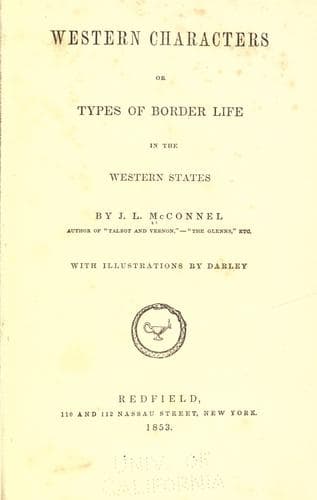
Western Characters; or, Types of Border Life in the Western StatesMcConnel, John Ludlum
General
Western Characters; or, Types of Border Life in the Western States
McConnel, John Ludlum
Frontier and pioneer life -- Mississippi River Valley; Mississippi River Valley -- Social life and customs
Errors in religion were too tremendous to be tolerated for a moment, and
the form (or rather anti-form) of worship handed down by her fathers,
had cost too much blood and crime to be oppugned. She thought
Barebones's the only godly parliament that ever sat, and did not hate
Hume half so much for his infidelity, as for his ridicule of the
roundheads. Her list of martyrs was made up of the intruders ousted by
Charles's "Act of Conformity," and her catalogue of saints was headed by
the witch-boilers of Massachusetts Bay. She abhorred the memory of all
_popish_ persecutions, and knew no difference between catholic and
cannibal. Her running calendar of living saints were born "to inherit
the earth," and heaven, too: they possessed a monopoly of all truth, an
unlimited "indulgence" to enforce conformity, and, in their zeal, an
infallible safeguard against the commission of error. She had no
patience with those who could not "see the truth;" and he who reviled
the puritan mode of worship, was "worse than the infidel." The only
argument she ever used with such, was the _argumentum ad hominem_, which
saves the trouble of conviction by "giving over to hardness of heart."
New England was, to her, the land of Goshen--whither God's people had
been led by God's hand--"the land of the patriarchs, where it rains
righteousness"[81]--and all the adjacent country was a land of Egyptian
darkness.
She was commendably prudent in her personal deportment: being thoroughly
pure and circumspect herself, she could forgive no thoughtless
imprudence in her sister-woman: but she well-understood metaphysical
distinctions, and was tolerant, if not liberal, to marriageable men.
These she could hope to reform at some future time: and she had,
moreover, a just idea of the weakness of man's nature. But being a
woman, and a staid and sober-minded woman, she could never understand
the power of temptation upon her own sex, or the commonest impulses of
high spirits. Perhaps she was a little deficient in charity: but, as we
have seen, it was chiefly toward her female friends, and since none can
bear severe judgment more safely than woman, her austerity did little
harm.
But she sincerely regretted what she could never palliate; she hated not
the guilty, though she could not forgive the sin; and no one was more
easily melted to tears by the faults, and particularly by the _follies_,
of the world. Wickedness is a very melancholy thing, but it is to be
punished as well as lamented: and like the unfortunate governor who was
forced to condemn his own son, she wept while she pronounced judgment.
But earthly sorrow, by her, was given only to earthly faults: violations
of simple good morals, crimes against heavenly creeds and forms (or
rather _the_ form) of worship, claimed no tear. Her blood rose to
fever-heat at the mention of an unbeliever, and she would as soon have
wept for the errors of the fallen angels, as for those of
anti-Robinsonians.
Public-domain text, read in full here on John Shaqi.
Reviews
Reviews
No reviews yet
Be the first to share your thoughts on this work.
Elsewhere in the archive
Join the Discussion
Join the discussion
Sign in to leave a comment or review.
Sign InorCreate an account