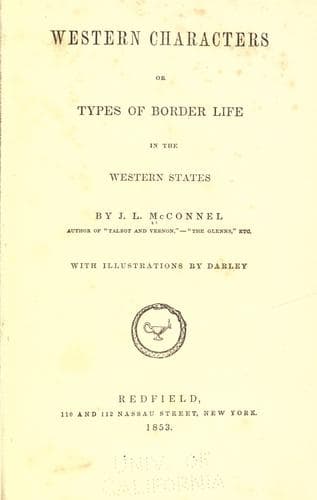
Western Characters; or, Types of Border Life in the Western StatesMcConnel, John Ludlum
General
Western Characters; or, Types of Border Life in the Western States
McConnel, John Ludlum
Frontier and pioneer life -- Mississippi River Valley; Mississippi River Valley -- Social life and customs
The large majority of men are sufficiently candid to acknowledge--at
least to themselves--that they are unfit for the station of law-giver;
but the vanity and jealousy begotten by participation in political
power, lead many of them, if not actually to believe, at all events to
_act_ upon the faith, that men, no more able than themselves, are the
best material for rulers. It is a kind of compromise between their
modesty and self-love: not burthening them with the trials and
responsibilities of positions for which they feel incompetent, but
soothing their vanity by the contemplation of office-holders not at all
their superiors. Below a certain (or uncertain) grade, therefore,
political stations are usually filled by men of very moderate abilities:
and their elevation is favored--indeed, often effected--by the very
causes which should prevent it. Such men are prone to thrust themselves
upon public notice, and thus secure, by persistence and impudence, what
might not be awarded them on the score of merit.
It is a trite remark, that people are inclined to accept a man's
estimate of himself, and to put him in possession of that place, in
their consideration, which he has the hardihood to claim. And the
observation is just, to this extent: if the individual does not respect
himself, probably no one else will take that trouble. But in a country
where universal suffrage reigns, it may be doubted whether the elevation
of an ordinary man indicates any recognition of the justice of his
claims. On the contrary, they may be endorsed precisely because they are
false: that is, because he really possesses no other title to the
support of common men, than that which is founded upon fellow-feeling or
sympathy of character. Many a man, therefore, who receives his election
as a compliment from the voters, if he understood the motives of their
action, would throw up his office in disgust; for in a large majority of
cases, the popular choice, so far from being an assertion of the
candidate's peculiar fitness to be singled out from among his brethren,
is only a declaration that neither talent nor character entitles him to
the distinction. The cry that a man is "one of the people," will bring
him great strength at the ballot-box: but this is a phrase which means
very different things, according as it is used by the candidate or the
voter; and, in many cases, if they could thoroughly understand each
other, the latter would not give his support, and the former would not
ask it.
Public-domain text, read in full here on John Shaqi.
Reviews
Reviews
No reviews yet
Be the first to share your thoughts on this work.
Elsewhere in the archive
Join the Discussion
Join the discussion
Sign in to leave a comment or review.
Sign InorCreate an account