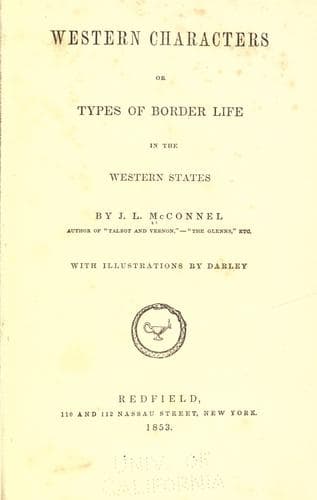
Western Characters; or, Types of Border Life in the Western StatesMcConnel, John Ludlum
General
Western Characters; or, Types of Border Life in the Western States
McConnel, John Ludlum
Frontier and pioneer life -- Mississippi River Valley; Mississippi River Valley -- Social life and customs
In those times, therefore, though a few were looking forward to separate
political organization and the erection of new states, the larger number
of the western people were too constantly occupied with their defence,
to give much attention to internal politics. Such organization as they
had was military, or patriarchal: the early pioneer, who had
distinguished himself in the first explorations of the country, or by
successfully leading and establishing a new settlement, as he became the
commander of the local fort, was also the law-giver of the community.
The pressure of external danger was too close to allow a very liberal
democracy in government; and, as must be the case in all primitive
assemblages of men, the counsels and commands of him whom they knew to
be the _most able_, were always observed. He who had proven himself
competent to lead was, therefore, the leader _ipso facto_ and _de jure_;
and the evidence required was the performance of such exploits, and the
display of such courage and sagacity, as were necessary to the defence,
well-being, and protection of the community.
It is obvious that no mere pretender could exhibit these proofs; and
that, where they were taken as the sole measure of a man's worth,
dexterity with a rifle must be of more value than the accomplishments of
a talker--Indian-fighting a more respectable occupation than
speech-making. Small politicians were, therefore, very small men, and
saying that one had "a turn for politics," would have been equivalent to
calling him a vagabond. The people had neither time nor patience to
listen to declamation--the man who rose in a public assembly, and called
upon his neighbors to follow him in avenging a wrong, made the only
speech they cared to hear. "Preambles and resolutions" were unmeaning
formalities--their "resolutions" were taken in their own minds, and, to
use their own expressive words, they executed them "without preamble."
An ounce of lead was worth more than a pound of advice; and, in the
vindication of justice, a "charge" of gunpowder was more effectual than
the most tedious judicial harangue. It is, even now, a proud, but
well-founded boast, of western men, that these traits have been
transmitted to them from their fathers--that they are more remarkable
for _fighting_ than for _wrangling_, for _acting_ than for _talking_.
Public-domain text, read in full here on John Shaqi.
Reviews
Reviews
No reviews yet
Be the first to share your thoughts on this work.
Elsewhere in the archive
Join the Discussion
Join the discussion
Sign in to leave a comment or review.
Sign InorCreate an account